TUESDAY

New BLOG – Great ARTICLES
TUESDAY 9 -[8]-26
SPIRITUAL:
The Turning Point:

David Jeremiah...
Tuesday, September 8Discipline for Our Good For [our fathers] indeed for a few days chastened us as seemed best to them, but He for our profit, that we may be partakers of His holiness.Hebrews 12:10 The New Testament occasionally uses the earthly family to illustrate God’s familial relationship with us (Romans 8:15-17). The writer to the Hebrews compares how earthly fathers discipline their children to the ways that God disciplines us (Hebrews 12:1-13). His purpose is for us to be “partakers of His holiness.”
Recommended Reading:James 1:2-4
The story of Jonah is a good example of God’s discipline. The discipline started with a storm at sea that resulted in Jonah being thrown into the deep where he was swallowed by a great fish. During his three days in the fish, Jonah called out to God and repented of his sin. After Jonah was deposited onto dry land, he obeyed God’s original commission to go to Nineveh and warn them of God’s impending judgment. While Jonah struggled with yielding to God’s purpose, the hardship he endured at least led him to repent of his initial disobedience.If you find yourself in a season of hardship, seek the Lord and ask Him if there is something He wants you to do or learn. Those that would enjoy the dignities and privileges of Christ’s family must submit to the discipline of it. Matthew Henry
Read through the Bible:Ezekiel 44–46
Creation Takes Over Evolution
- Creation Research News

Summary of the Creation Discovery Centre Newsletter [ChatGPT]
This newsletter, introduced by Craig Hawkins, Director, combines Christian creationist science, biblical history, and contemporary social issues. Hawkins says the edition contains major news about the Tasmanian Creation Discovery Centre, experiments concerning rapid oil formation, current social questions, and several science reviews by Dr. Diane Eager.
Main stories
“We Bought Evolution! (No, really)”
The Creation Discovery Centre in Tasmania announces what it calls a major step forward in its outreach—the acquisition of something associated with “evolution.” The excerpt is deliberately playful and does not explain exactly what was purchased; readers are directed to the full article.
Fast Oil Experiments
The newsletter examines the origin of the world's large petroleum deposits. It notes estimates that more than 1.5 trillion barrels of oil remain trapped within sedimentary rock and asks how so much petroleum formed and became embedded in Earth's crust. The article appears intended to challenge conventional assumptions about how long oil formation requires from a creationist perspective.
“What Has Christianity Ever Done for Women?”
Prompted by a question asked at a university debate between sceptics and Christians, this article addresses the contention that Christianity has historically done little or nothing to benefit women. The newsletter regards the question as legitimate but challenges its underlying assumption.
Anti-Conversion Legislation in Tasmania
The newsletter discusses proposed Tasmanian anti-conversion legislation. It presents the concern of Christian lobby groups that the proposals could represent an unusually severe restriction on Christian faith and practice and asks what the legislation could mean for churches.
Did Jesus Baptise People in Central Australia?
An Aboriginal pastor reportedly made a claim concerning Jesus baptising people in Central Australia. Rather than simply accepting the assertion, the newsletter frames the controversy around a larger question: What authority should Christians trust when evaluating historical claims and biblical truth?
A Warm Ancient Canadian Arctic
Dr. Diane Eager discusses fossil evidence indicating that northern Canada once experienced a warm or subtropical climate. The article considers how such evidence might be interpreted within a creationist worldview.
Caribbean Lizards and Evolution
Scientists studying lizards on hurricane-prone Caribbean islands have suggested that observed changes could demonstrate evolution occurring in real time. The newsletter questions that interpretation and promises an alternative explanation of the findings.
“Living Fog Cleans Air”
Researchers discovered that bacteria present in fog are apparently biologically active rather than merely floating passively in the atmosphere. The newsletter considers what this discovery might reveal about the complexity of the natural—or, in its terminology, “created”—world.
Overall message
The central theme running through the newsletter is that biblical Christianity and a creationist interpretation of science provide an alternative framework for understanding both scientific discoveries and modern social controversies.
It mixes three broad subjects: creation science (oil, fossils, lizards, atmospheric bacteria), Christian apologetics and history (Christianity's treatment of women and claims concerning Jesus in Australia), and religious/cultural issues (Tasmania's proposed conversion legislation). The complete edition lists eight principal articles.
One important qualification: the material you've given me is essentially the newsletter's introductory/preview version. Several entries provide only a short teaser followed by “Read More,” so it doesn't contain enough information to summarize the full arguments or evidence of those articles.
ChatGPT

MEDICAL:
dmso-reminder bringing dmso for purchase $8.00 a bottle with recipes..next meeting [The TEN]

CANADIAN:
Trump to Canadian plane maker Bombardier: You can't sell in U.S. unless you build in U.S.
President's social media post comes amid Canada's counter-tariff plans, broken trade talks

Summary [ChatGPT]
Donald Trump threatened Bombardier, saying the Montreal-based aircraft manufacturer should no longer be allowed to sell jets in the U.S. unless it manufactures there. He criticized the company’s products and accused it of treating the U.S. as a “piggybank.”
The threat comes amid escalating Canada-U.S. trade tensions, with Canada preparing new counter-tariffs against U.S. goods.
Bombardier already has a significant U.S. presence. It employs about 3,500 Americans, works with roughly 2,800 U.S. suppliers, operates factories and service centres there, and manufactures Global 8000 wings in Texas.
Industry experts question whether Trump could realistically block Bombardier sales. Bombardier aircraft already meet U.S. regulatory requirements and CUSMA rules, and many use American-made engines from companies such as Honeywell and GE Aerospace.
Bombardier's U.S. customer base is substantial: roughly half of the 5,100 aircraft operated by its customers are located in the United States.
Quebec Premier Christine Fréchette defended the company, calling Bombardier a source of pride and an important part of Quebec's aerospace industry. She said she had contacted CEO Éric Martel to offer government support.
The dispute isn't new. Trump previously threatened Bombardier with 50% tariffs on Canadian-made aircraft and questioned certification of its Global Express jets, but those measures ultimately did not materialize.
Bombardier is continuing to invest in Canada, announcing on Sept. 1 that it would acquire a Canadian factory from Mitsubishi Heavy Industries that produces wings for its Global 5500 and 6500 aircraft.
The broader concern is escalation. McGill aerospace and supply-chain expert John Gradek suggested Bombardier could be the “first of many” Canadian companies targeted as the trade dispute intensifies.
Bottom line
Trump's statement is primarily a pressure tactic to encourage manufacturing in the U.S., but actually banning Bombardier aircraft would be complicated because Bombardier's operations and supply chain are deeply integrated with the American aerospace industry. It could also hurt U.S. workers, suppliers, customers and aircraft operators—not just the Canadian company.
Midnight [Tuesday AM... 00:01] Canadian Tariffs ‘Kick-In’... TRUMP will make CANADA feel Economic PAIN!
TIME-will-tell... The IMPACT!
ChatGPT
TRUMP:
Arizona Democrat vows to investigate all Trump children if party retakes the House

By
Rep. Yassamin Ansari laid out a sweeping Democratic plan to target every one of President Trump's adult children with congressional investigations, a move that reveals less about alleged wrongdoing than about the party's midterm strategy.
Ansari, a freshman Democrat from Arizona, appeared on MSNBC's "Alex Witt Reports" on Saturday and rattled off the names of Eric Trump, Donald Trump Jr., and Barron Trump as targets for congressional subpoenas should Democrats flip the House in November. She offered no evidence for the accusations she leveled against each of them, instead stringing together allegations about defense contracts, cryptocurrency ventures, and personal associations as though assertion alone constitutes a case.
The appearance followed reports that House Oversight leader Robert Garcia and Judiciary leader Jamie Raskin have signaled plans to subpoena senior Trump administration officials and family members if Democrats win the majority. No subpoenas have been issued. No formal investigations have been opened. Every action Ansari described remains conditional on an election outcome that has not happened yet, which makes her interview less a policy announcement than a campaign advertisement dressed up as oversight.
Ansari names three Trump children, [backs none of it up]!
Host Alex Witt set the table by asking where Democrats should begin their investigative agenda. Ansari responded with a broad indictment of the entire Trump family:
"The corruption and the authoritarianism of this regime is so rampant that the list is going to be long. But look, I think first and foremost, we need to focus on the vast corruption that's taken place. We need to look at the Trump family, all, not only Donald Trump himself, but all of the Trump children who are full grown adults, whether it's Eric Trump, Don Jr., Barron Trump."
She then went further, attaching specific but unsupported allegations to individual family members. She claimed Don Jr. had "forced the government to engage in" defense contracts and accused Barron Trump of running "crypto schemes" and maintaining a "friendship with people like the Tate brothers." She offered no documentation, no contract numbers, no filing references, and no dates for any of these claims.
Ansari also asserted that the Trump family had used the presidency "to make billions of dollars." That figure, billions, went unchallenged by Witt, who asked no follow-up questions about the basis for any of the allegations.
No subpoenas filed, no investigations opened
Every investigative action Ansari described is prospective. Garcia and Raskin have reportedly indicated their intentions, but neither has issued a subpoena or opened a formal inquiry into any Trump family member. The entire framework depends on Democrats winning the House majority in November, an outcome that is far from certain.
That distinction matters. Announcing investigations before holding the gavel is a political tactic, not a legal one. It puts names in headlines, forces opponents to respond, and frames a midterm campaign around accountability rhetoric that may never produce an actual hearing. Democrats have repeatedly pledged aggressive investigations as a centerpiece of their midterm pitch, making oversight less a governing function than a fundraising hook.
The strategy carries a familiar risk. Voters who watched years of congressional investigations during the first Trump administration, investigations that consumed enormous institutional energy and produced mixed results, may be skeptical of a party promising to do it all over again, this time with the president's children as the headline targets.
Democrats spread their focus across multiple fronts
Ansari's appearance fits a broader pattern of Democrats casting a wide net heading into November. The party has shifted fire toward various administration figures as part of a midterm messaging strategy that treats nearly every Trump-adjacent official or family member as a potential investigation target.
Meanwhile, congressional Democrats have also been active on immigration policy. More than a dozen Democratic lawmakers recently sent a letter urging the Trump administration to pause deportation flights for Iranian nationals and designate them for Temporary Protected Status. The letter, directed to DHS Secretary Markwayne Mullin, Secretary of State Marco Rubio, and other officials, argued the administration bears a "moral and humanitarian responsibility" to shield Iranians from removal. That push came even as Secretary Rubio revoked the legal status of individuals with ties to the Iranian regime, including relatives of IRGC General Qasem Soleimani.
The juxtaposition is instructive. On one hand, Democrats demand the administration protect foreign nationals from enforcement actions. On the other, they promise to weaponize congressional subpoena power against the president's own family. The common thread is not principle, it is opposition.
Republicans, for their part, have been building their own case against the Democratic midterm roster. RNC Chairman Gruters has laid out what the party sees as vulnerabilities across Democratic candidates and incumbents, arguing that the investigation-heavy messaging alienates voters who want Congress focused on inflation, border security, and economic growth rather than political score-settling.
Unsubstantiated claims treated as settled fact on air
What stood out most about the MSNBC segment was what was missing: any pushback. Witt's question assumed the legitimacy of the oversight agenda from the start, framing it as a matter of where Democrats "should begin" rather than whether the proposed investigations had factual grounding. Ansari's claims about defense contracts, cryptocurrency, and the Tate brothers went entirely unexamined.
No one asked which defense contracts Don Jr. allegedly forced the government to sign. No one asked what "crypto schemes" Barron Trump supposedly runs. No one asked what the Tate brothers have to do with congressional oversight jurisdiction. The segment treated accusations as interchangeable with evidence, a habit that erodes public trust in both the press and the legislative process.
The Trump White House has undergone its own personnel transitions in recent months, including changes at the press secretary level, but the administration's staffing decisions are a separate matter from the unsubstantiated corruption allegations Ansari aired on cable television.
Ansari's willingness to name Barron Trump, the youngest of the president's children, is worth noting on its own terms. Previous administrations' minor and young-adult children were generally treated as off-limits by both parties. Naming him on national television alongside specific allegations, without evidence, represents a departure from that norm. Whether voters reward or punish that approach will say something about where the country's political culture stands.
A campaign promise, not an oversight plan
Strip away the rhetoric and what Ansari offered on Saturday was not a blueprint for congressional accountability. She named no witnesses, cited no documents, referenced no statutes, and identified no committee jurisdictions. She produced a list of targets and a set of allegations, the raw materials of a campaign ad, not a congressional investigation.
That does not mean the allegations are false. It means they are unproven, and the congresswoman who made them showed no interest in proving them during the one public forum where she had the chance. If Democrats win the House and follow through, the investigations will have to stand on evidence, not cable-news sound bites. If they lose, the promises will join a long list of midterm pledges that never had to survive contact with reality.
Congressional oversight works when it follows facts. When it follows political calendars, it is just another form of campaigning, and voters can usually tell the difference.
The AMERICAN Almanac
GLOBAL:
The CAPITALIST


èCAP-6

The CAPITALIST
Patrick Bestall’s INPUT:
èPATRICK

#1.
85% of Iranians want regime to Fall

How long will the people of Iran, 85% of whom say in polls that they want the regime to fall, endure this state of affairs before they come out in protest again, as they did last January?
Summary: Iran’s Economy in “Free Fall” [ChatGPT]
The article argues that Iran is experiencing a severe economic crisis, intensified by the Trump administration’s sanctions and blockade. While Iranian officials publicly maintain that U.S. pressure is ineffective, the article says the consequences are increasingly visible in everyday life, including markets, pharmacies, employment, and household finances.
Main points:
Ordinary Iranians are bearing the economic burden. According to the article, many struggle to afford food, medicine, utilities, and education, while employment opportunities—particularly for young people—are scarce. It states that only 37% of Iran's adult population is employed.
The article attributes much of the crisis to both U.S. pressure and decisions by Iran's leadership. It argues that continued closure of the Strait of Hormuz is preventing sanctions and the blockade from being lifted.
Government spending is portrayed as a major source of public resentment. The author claims Iran has spent more than $100 billion on its nuclear program and billions more supporting Hamas, Hezbollah, the Houthis, and other proxies rather than improving living conditions at home.
The article predicts renewed anti-government protests. Its author believes worsening poverty could eventually drive millions of Iranians into the streets and speculates that members of the Basij or Islamic Revolutionary Guard Corps might ultimately refuse orders to suppress demonstrators.
The comments add a more dramatic picture
Commenters claim that the currency's volatility has become so extreme that some businesses continually adjust prices, while Iran is experiencing fuel shortages, long gasoline lines, energy problems, business closures, and disruptions to hospitals and food storage. These are claims made by commenters rather than independently established facts in the article itself.
One lengthy comment argues that economic pressure is now beginning to hurt IRGC and regime-connected interests themselves, rather than merely ordinary Iranians. It cites Iranian expatriate commentators who estimate that only 5–10% of Iranians actively support the regime, but again, that figure comes from the comment section and isn't substantiated within the supplied material.
Bottom line
The central argument is that Trump's economic-pressure strategy is severely weakening Iran's economy and potentially the regime's domestic support, while Iran's rulers continue prioritizing military, nuclear, and regional activities over their population's economic welfare. The author expects worsening conditions eventually to produce another mass uprising and hopes that, unlike previous protests, elements of Iran's security forces will turn against the government.
Importantly, the piece mixes reported economic information, the author's political interpretation and predictions, and highly speculative reader comments. Those three categories shouldn't be treated as equally established facts.
ChatGPT
.PB
#2.
What do Amish and Mormons have in common?

èDRUTH-1
èDRUTH-2
èDRUTH-3


RELATED
Read the above excerpt from Druthers, "Live Like the Amish"
.PB
#3.
Dr. Trozzi reports

The sale of raw milk is outlawed in Canada but in the United States, 47 of 50 states permit the sale of raw milk. Listing of raw milk sellers globally: Link↗
We must give credit when it is due; here is a medical doctor telling the truth about natural immunity (Fauci in 2004) Link↗
A U.S. appeals court has entered a judgment in favor of James O’Keefe, founder of Project Veritas, and a Project Veritas reporter. A split panel of U.S. Court of Appeals for the District of Columbia Circuit judges said on Aug. 21 that a district court judge had erroneously kept in place $130,000 in damages against O’Keefe over an undercover operation that targeted Democratic strategists. “The principal question in this appeal is whether the jury’s damages award violated the First Amendment by punishing the defendants for publishing a news story,” Circuit Judge Karen LeCraft Henderson, writing for the majority, said. “We conclude that it did.”
A U.S. appeals court has entered a judgment in favor of James O’Keefe, founder of Project Veritas, and a Project Veritas reporter. A split panel of U.S. Court of Appeals for the District of Columbia Circuit judges said on Aug. 21 that a district court judge had erroneously kept in place $130,000 in damages against O’Keefe over an undercover operation that targeted Democratic strategists. “The principal question in this appeal is whether the jury’s damages award violated the First Amendment by punishing the defendants for publishing a news story,” Circuit Judge Karen LeCraft Henderson, writing for the majority, said. “We conclude that it did.”
Combing through reports from more than 1,200 weather stations across the United States, former University of Alabama climatologist John Christy’s analysis challenges a commonly held belief that extreme high temperatures have become more prevalent. According to his report, published this spring in the academic journal Theoretical and Applied Climatology, the data don’t show an increase in extreme temperatures; rather, they indicate that temperatures have become more moderate over the past century.
Christy’s analysis indicates that the period with the most extreme high temperatures was the 1930s, not recent decades as is often reported. Instances of extreme heat have not increased significantly over the past century, Christy stated, and there are fewer cases of extreme cold. “If your political view is that extremes are getting worse and worse, that’s almost a religion, so you can’t really change minds on that,” Christy said. Christy believes it’s difficult for academics who question the prevailing narratives on climate to secure grants or be published. Link↗
The Amish did not participate in any of the covid agenda. They did not mask, social distance, close their schools, churches or businesses. They did not invite nor submit to the injection campaigns. Amish people over 60 years old had a 23 times lower Infection Fatality Rate than the rest of the country. For all age groups combined, their infection fatality rate from COVID was at least 90 times lower than the surrounding community. Link↗
This week’s CTA
Help Sarah Choujounian: the nurse being tortured for protecting her patients and alerting the public. Link↗
.PB
#4.
US losing Farmers to Bankruptcy & Suicide (over 3 times [3X] higher than Avg.)

1. “Too Important To Fail’ – American Farmers Going Bankrupt At a Record Breaking Pace (video 13:47)
.PB
#5.
Canada's Hungry

.PB
#6.
Study of "Active Religious" People = 10X less Anxiety, Depression & Suicide
Times definitely change, and the 2026 data actually reflects that.
While the 2020 cohort study established the initial data, the Harvard Meta-Analysis was published in February 2026, and a massive research review by the Wheatley Institute was released in May 2026. These studies are completely modern and took into account how shifting cultural trends affect mental health. [1, 2, 3]
The updated findings from the May 2026 Wheatley Institute Report analyzed thousands of peer-reviewed studies across multiple decades up to the present day: [2]
· The 10-to-1 Margin: Across all high-quality modern research, positive mental health associations with active religious involvement outnumbered negative ones by roughly 10 to 1. [2]
· The Post-Pandemic Suicide Spike: Researchers estimated that the overall decline in weekly religious attendance over recent years may account for approximately 40% of the rise in the U.S. suicide rate. [3]
· Anxiety and Depression: Out of the most rigorous contemporary studies reviewed, 74% documented better depression outcomes and 69% reported lower anxiety levels among actively religious individuals. [3]
The 2026 Modern Twist: Isolating the Shifting Dynamics
Because times have changed, researchers in 2026 have actively tried to figure out why this gap exists, especially as traditional religious attendance declines. A longitudinal study published in April 2026 (Religions) specifically tracked families who identify as "Spiritual But Not Religious" (SBNR). [4]
The data found that while solitary spiritual practices help reduce depression over time, children and young adults in purely SBNR categories initially reported the highest baseline levels of anxiety and depression. This reinforces the modern consensus: belief alone isn't the protective factor; it is the physical, structured community routine that modern society is struggling to replicate. [4, 5]
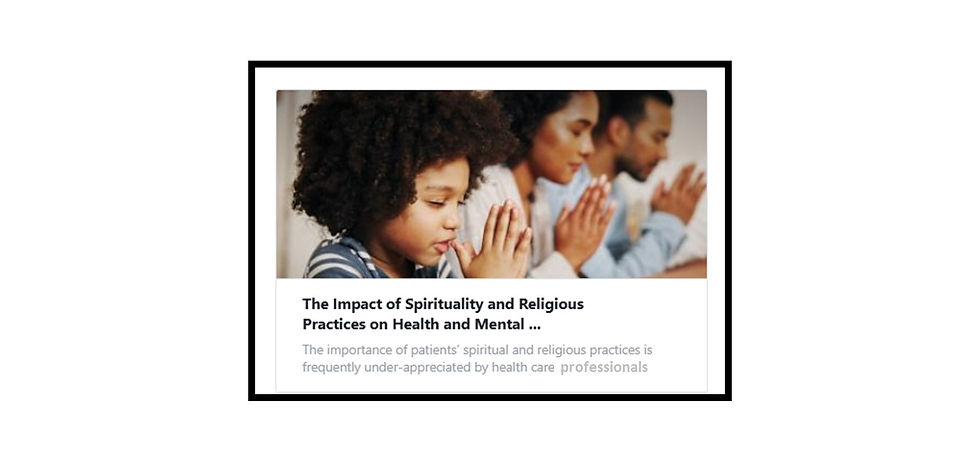
Are you curious about how clinical psychologists in 2026 are trying to bridge this gap for non-religious patients, or would you like to see how these statistics hold up across different age demographics?
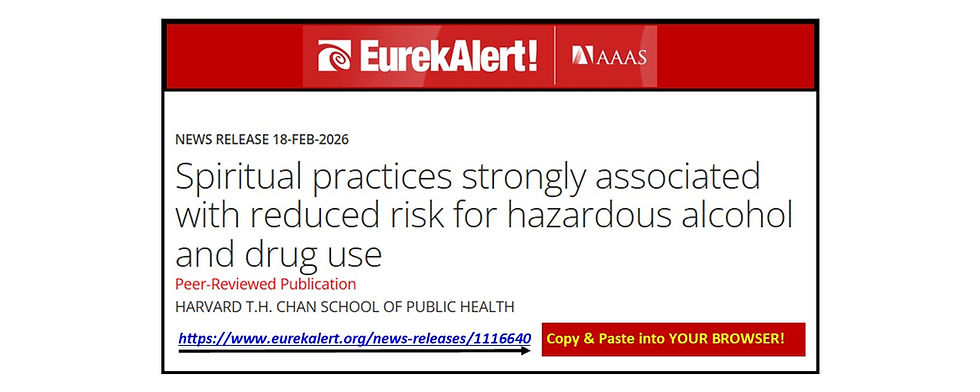
The specific article you quoted comes from a feature published on the National Alliance on Mental Illness (NAMI) Blog. [1]
While the NAMI article synthesizes a broad body of public health literature rather than referencing just a single trial, the core data backing up those exact claims is anchored by a few landmark, large-scale studies.
The two most definitive, high-impact research studies mapping directly to NAMI's statement include:
1. The Harvard "Deaths of Despair" Cohort Study (2020)
Published in JAMA Psychiatry, this extensive longitudinal study explicitly looked at what public health officials call "deaths of despair"—specifically suicide, drug overdose, and alcohol poisoning. [2, 3]
· The Scope: Researchers from the Harvard T.H. Chan School of Public Health tracked data from over 109,000 U.S. health professionals over several decades. [3, 4]
· The Findings: The study revealed that women who attended religious services at least once a week had a 68% lower risk of death from despair compared to those who never attended. For men, the risk was 33% lower. [3, 4]
2. The Comprehensive Harvard Meta-Analysis on Substance Misuse (2026)
For a direct look at the relationship with addiction, a major meta-analysis was also published in JAMA Psychiatry. [5]
· The Scope: This study synthesized data across 55 distinct, long-term studies following more than 540,000 adults over a 21-year period.
· The Findings: It concluded that regular spiritual and religious community involvement was associated with a 13% to 18% reduced risk of hazardous drug, alcohol, tobacco, and marijuana use. The highest preventative benefit (18%) was tightly bound to the exact aspect NAMI highlights: regular, weekly active community participation. [5, 6, 7, 8, 9]
Would you like to look closer into the methodology of how researchers separate religious involvement from other social factors, or explore the psychological mechanisms (like the "relaxation response" or cognitive coping) mentioned in these texts?
Yes, researchers can and do separate the data by specific religious groups, though doing so reveals a critical distinction in public health research: the mental health benefits are driven almost entirely by the intensity of community practice, rather than the specific theology of the religion.
Large-scale public health studies—such as the 2026 Harvard Meta-Analysis and the 2026 Wheatley Institute Report—categorize and study religious groups in two main ways: [1, 2]
1. The Theological and Denominational Differences
When public health records isolate data by specific affiliations, distinct statistical trends emerge across different groups regarding suicide, alcohol, and drug use:

2. Why Researchers Prefer "Religiosity" Over "Denomination"
While data can be separated by religion, modern researchers found that looking only at the name of the religion gives an incomplete picture. For example, a person who checks "Catholic" on a survey but never goes to mass does not experience the protective benefits against depression or addiction. [3]
Because of this, 2026 epidemiological frameworks focus heavily on Organizational Religiosity (how often you physically attend a temple, church, or mosque). The data shows that a highly active Muslim, an orthodox Jew, and an evangelical Christian experience nearly identical drops in "deaths of despair" because the underlying mechanics—the weekly routine, the shared moral accountability, and the immediate social support network—are functionally the same. [2, 4, 5]
.PB
RUMOUR:
RUMOURS Circulating out there...:
Disclaimer: All articles, videos, and images posted on Operation Disclosure were submitted by readers and/or handpicked by the site itself for informational and/or entertainment purposes. All statements, claims, views, and opinions that appear on this site are always presented as unverified and should be discerned by the reader. We do not endorse any opinions expressed on this website, and we do not support, represent or guarantee the completeness, truthfulness, accuracy, or reliability of any content posted on this website.
I may not agree with everything from the content-producers that I share.
Apply critical thinking and use discernment to
Come to your own conclusions regarding the content!
You need to MAKE UP Your own MIND!
What we think that we now know...
REPORT Today
The world keeps spinning, and now you’re caught up.
Rob Cunningham: Words have Consequences, Powerful Institutions have Responsibilities

WORDS HAVE CONSEQUENCES POWERFUL INSTITUTIONS HAVE RESPONSIBILITIES
The First Amendment is indispensable to America. But acknowledging that protection does not require Americans to pretend that organized deception is harmless.
A wealthy and influential organization can possess vastly greater capacity than an ordinary citizen to manufacture narratives, distribute information, influence institutions and shape public confidence. Foreign financing, coordinated activity or enormous corporate resources can make that influence still more dangerous and consequential.
The constitutional answer, however, must remain constitutional.
If an organization merely criticizes our President, challenges government policy or publishes research reaching a conclusion the government believes is wrong, the First Amendment provides formidable protection.
But when evidence establishes independently unlawful conduct – fraud, actionable defamation, unlawful foreign coordination, conspiracy, obstruction, threats, or other defined patterns and history of repeated offenses – the First Amendment does not magically immunize that conduct simply because words were among the instruments employed.
The President’s oath is therefore neither a license for retaliation nor a command for passivity.
It is a command to faithfully execute the law.
Investigate credible evidence.Follow the money where the law permits.Establish who knew what, and when.Distinguish honest error from knowing fabrication.Determine whether protected advocacy ended and independently unlawful conduct began.
Then let the evidence speak.
If there is no violation of law: protect the speech.
If there is a civil wrong: prove it in court.
If there is a crime: enforce the law.
Neither wealth, political influence, corporate power, foreign connections nor opposition to a President determines guilt.
Evidence does. Law does. Due process does.
That is not weakness in the face of propaganda.
That is constitutional power disciplined by constitutional truth.
No Kings, right?
This coordinated gaggle of global lunatics include George Soros, Bill and Melinda Gates, Google, Apple, Visa, Goldman Sachs, Citigroup, WellsFargo, Bank of America, Walmart, Toyota, T-Mobile, and NBC Universal.
Foreign support includes the Embassy of Japan, the Korea Foundation, Taipei Economic and Cultural Representative Office (Taiwan), and the Embassy of the United Arab Emirates.
Let’s follow the money, ignore zero credibility Fake News propagandists with TDS, and let the lawful chips fall where they may.
Contact AuthorIf you wish to contact the author of this article. Please email us at [voyagesoflight@gmail.com]. Availability of author’s contact information depends on if said article was user submitted or reposted.
=======
Rob Cunningham: Top 10 Impacts of Abraham Lincoln

Who was Abraham Lincoln?What were his Top 10 Impacts?When was he murdered?Where are these truths taught?Why, and by whom, was he k----d?
Says who?
Who writes “official” history?What happens when liars “lead?”What is the cost of ignorance?
Says who?
Who hates Trump?Who really hates Trump?Who needs Trump dead & gone?Who propagates MAGA hatred?Who invents money?Who issues money?Who regulates money?Who controls all the money?Who controls all the world?
Says who?
Who is reinventing and leading the restoration of money as an honest, accountable, inspectable and open source value exchange system the world over?
Who wants to transfer power back to “ We the People?”
Says who?
Do actions speak louder than counterfeit money can lie?
Dogs bark. Cows moo. Liars lies.
“The power of death and life flow from the tongue.”
Contact AuthorIf you wish to contact the author of this article. Please email us at [voyagesoflight@gmail.com]. Availability of author’s contact information depends on if said article was user submitted or reposted.
========
The END
![MONDAY [LABOURDAY]](https://static.wixstatic.com/media/7f1dc1_5ebe8b8956b24ade89a19288611b26b7~mv2.jpg/v1/fill/w_600,h_300,al_c,q_80,enc_avif,quality_auto/7f1dc1_5ebe8b8956b24ade89a19288611b26b7~mv2.jpg)

Comments