TUESDAY [PART-ONE]

Updated: Jul 21
New BLOG – Great ARTICLES
TUESDAY 7 -[21]-26
SPIRITUAL:
Verse-for-TODAY:
New International Version
I have chosen the way of faithfulness; I have set my heart on your laws.
Read all of Psalm 119 ►
5th Generation Warfare
I just came across this this morning, about 5th Generation Warfare.
This fits to what is going on in the world, and the large addiction by large amounts of people to devices.
5th Generation Warfare is the attack on the mind…
There is this short clip…
Then this much longer clip that explains in detail how warfare over the years changed…
But then I came across this amazing young man that has captured it well, as to how Christians get the victory!
It is not just reading the Bible (although that is good), nor memorizing Scripture (although that is good).
So, watch this all the way through…
I then realized that is what has been giving me the victory!
My last pastor did not like that term victory, but now I know I indeed have the victory through Jesus Christ.
That is the clear answer!
The Bible states to study the word to show thyself approved.
2 Timothy 2:15 "Study to show thyself approved unto God, a workman that needs not to be ashamed, rightly dividing the word of truth."
Praise God, and may we all find ourselves not slaves to the evil one & his system,
Brian Plum
We indeed have the ‘Victory’ through Jesus Christ.
CANADIAN:
The Surveillance State Is Built on a Simple Bargain: Trade Your Freedom for Safety

There is an old tension that has existed since the birth of civilization: how much liberty should a free people surrender in exchange for greater security? Every generation faces that question, but ours is confronting it in a way no previous generation ever has. We are not debating soldiers in our streets or checkpoints at city limits. We are debating algorithms, artificial intelligence, biometric databases, automated license plate readers, smart devices, and digital ecosystems that quietly record nearly every aspect of modern life.

The surveillance state has not arrived through a military coup or an authoritarian revolution. It has emerged gradually through technology that makes life easier, more convenient, and, in many cases, objectively safer. That is precisely why it deserves serious scrutiny. The greatest threats to liberty rarely announce themselves as threats.
They arrive wrapped in convenience, efficiency, and promises of public safety.
Having spent much of my career in Special Forces and later working in intelligence, I understand better than most that surveillance has legitimate and necessary applications. Intelligence collection has prevented terrorist attacks, dismantled criminal organizations, rescued hostages, and protected countless innocent lives. Used within clearly defined legal and constitutional boundaries, surveillance is one of the most powerful tools available to those charged with protecting a nation.
However, acknowledging its value does not eliminate the need for oversight. In fact, the more powerful a capability becomes, the greater the responsibility to ensure it is not abused. History consistently demonstrates that governments rarely relinquish authorities once they have acquired them. Powers granted during emergencies often become permanent fixtures long after the original crisis has passed. Measures introduced as temporary exceptions gradually become normalized until future generations accept them as ordinary.
The United States has experienced this pattern before. Following the attacks of September 11, Americans accepted extraordinary expansions of surveillance authorities because the country genuinely faced an unprecedented threat. Few questioned whether those powers would eventually be scaled back once the immediate danger subsided. Instead, many became institutionalized. Capabilities originally justified by counterterrorism concerns slowly found applications in routine law enforcement, administrative investigations, and regulatory enforcement. Whether one agrees with every individual program is almost beside the point. The larger lesson is that government authority tends to expand far more easily than it contracts.
Today, technology has accelerated this dynamic beyond anything policymakers of previous generations could have imagined. Automated license plate reader networks can document the movement of vehicles across entire metropolitan areas. Facial recognition systems are increasingly capable of identifying individuals within massive crowds. Smartphones continuously generate detailed location histories. Smart home devices listen for voice commands, while wearable technology records health data, movement patterns, and biometric information. Modern vehicles increasingly collect driving behavior, location information, and diagnostic data, with some models incorporating inward-facing cameras intended to improve driver safety.
Each individual technology can be justified on its own merits. A camera may help solve a homicide. A license plate reader may locate a kidnapped child. Driver monitoring systems may reduce fatigue-related crashes. The problem is not necessarily any single technology. The concern arises when these capabilities become interconnected, permanent, and largely invisible to the public.
At that point, the discussion must shift away from whether surveillance can accomplish good and toward more fundamental constitutional questions. Who owns the data? How long is it retained? Who has access to it? Under what circumstances can it be shared? What judicial oversight exists? Can it be sold to private companies? Can it later be repurposed for objectives that were never envisioned when the system was first deployed?
These questions are not expressions of paranoia. They are expressions of responsible citizenship.

One of the defining characteristics of constitutional government is that power is intentionally constrained because the founders understood that every institution, regardless of its original purpose, is ultimately operated by imperfect human beings. The Constitution does not exist because Americans distrust one particular administration or political party. It exists because human nature has remained remarkably consistent throughout history. Every administration eventually hands its authorities to the next one, including those with entirely different priorities, philosophies, and interpretations of the law. Powers that appear harmless under leaders we trust may become deeply concerning under leaders we do not.
This is why constitutional safeguards such as warrants, probable cause, judicial review, and due process have historically served as essential barriers between government authority and individual liberty. Technology now threatens to outpace many of those protections. Massive quantities of personal information can be collected, stored, analyzed, and cross-referenced long before a judge is ever involved. Artificial intelligence is increasingly capable of identifying behavioral patterns, relationships, and predictive models that were unimaginable only a decade ago. The legal framework governing these capabilities has struggled to keep pace with the speed of technological innovation.
There is also a profound psychological consequence to living under continuous surveillance. Human beings behave differently when they believe they are constantly being observed. They become more cautious about expressing unpopular opinions, more reluctant to challenge authority, and more inclined to censor themselves even when no law explicitly requires it. The mere perception of being watched alters behavior. This phenomenon has been studied extensively by psychologists and political scientists because it changes not only what people do but also what they are willing to think, discuss, and question.
A free society depends upon citizens who feel secure enough to engage in open debate without fearing that every movement, conversation, purchase, or association may someday be cataloged, analyzed, or interpreted outside its original context. Liberty is not merely the absence of physical restraint. It also requires the confidence to exercise constitutional rights without unnecessary government intrusion.
Benjamin Franklin is frequently credited with warning that those willing to sacrifice essential liberty for temporary safety deserve neither liberty nor safety. Historians continue to debate the precise context of that statement, but its underlying principle remains remarkably relevant. Every society must balance freedom with security. The danger lies in believing that security can be perfected through surveillance alone. Absolute safety is an illusion because risk is an unavoidable feature of human existence. Attempting to eliminate every conceivable danger inevitably requires expanding authority over nearly every aspect of daily life.
Preparedness has always meant more than storing food, carrying medical equipment, or building emergency plans. Genuine preparedness also requires understanding the systems that shape our lives and recognizing long-term trends before they become irreversible. Citizens should not reject technology simply because it exists, nor should they blindly embrace every innovation simply because it promises greater convenience. Instead, they should ask difficult questions about accountability, transparency, constitutional limits, and the preservation of individual liberty.
Technology itself is morally neutral. Artificial intelligence, biometric recognition, and digital surveillance possess enormous potential for both good and harm. Their ethical character depends entirely upon the legal, constitutional, and cultural boundaries imposed upon those who wield them. That reality places an enormous responsibility not only upon elected officials but also upon ordinary citizens who must remain engaged in the difficult work of preserving constitutional government.
The surveillance state did not emerge because Americans consciously chose to abandon freedom. It emerged because each incremental expansion appeared reasonable when viewed in isolation. One camera improved public safety. One database improved investigative efficiency. One emergency justified temporary authorities. One technological innovation promised greater convenience. None of these developments seemed individually transformative. Together, however, they have fundamentally altered the relationship between citizens, corporations, and the government.
The central question facing our generation is not whether technology will continue advancing. It undoubtedly will. The real question is whether our commitment to constitutional liberty, individual privacy, and limited government will advance alongside it. If we fail to preserve those principles with the same determination that we pursue technological progress, we may eventually discover that the freedoms previous generations fought to secure were not taken from us by force but surrendered gradually, one reasonable compromise at a time.
Mike Glover
from Mike’s Substack
TRUMP:
Donald Trump says Canadians ‘need us to survive’ after Mark Carney says trade talks will ‘intensify’

U.S. President Donald Trump speaks with Prime Minister Mark Carney at the G7 summit in Evian, France, on June 16, 2026.
Prime Minister Mark Carney said he spoke with Trump on Tuesday morning following Monday’s announcement that the United States plans to impose 50 per cent tariffs on a wide swath of Canadian goods in 30 days.
OTTAWA — Prime Minister Mark Carney says he has agreed to “intensify” trade negotiations with the U.S. after President Donald Trump threatened punishing new tariffs on Canada.
Carney said he spoke with Trump on Tuesday morning following Monday’s announcement that the United States plans to impose 50 per cent tariffs on a wide swath of Canadian goods in 30 days.
The new tariffs will apply to Canadian alcohol, autos and dairy products — sectors where the Americans argue Canada is discriminating against U.S. products — as well as a variety of other products including clothing, wood products, wigs and hockey sticks.
But speaking at the White House on Tuesday, the U.S. president said “Canada has been very, very tough on us over the years.”
“I love the people of Canada. (I have) many friends that live in Canada,” Trump said. “But their leadership, from (former prime minister Justin) Trudeau to the current leadership — I mean, in all fairness to them, they need us to survive. Without us, there’s no way they can survive.”
Carney said the newly announced tariffs would be another violation of the Canada-United States-Mexico Agreement on trade, but said that Canada and the U.S. will continue with efforts to renegotiate that deal.
“We agreed to intensify negotiations in the coming weeks, and the team and myself look forward to doing that,” Carney said outside his Ottawa office on Tuesday morning.
The new U.S. tariffs are set to be applied on Aug. 19.
Carney said his government’s first priority is reaching a comprehensive trade deal with the U.S., but that it is also looking at other responses to the U.S. action.
“We will look at all options in terms of how we would respond if they do come into effect,” he said.
The TORONTO STAR
Mace snubs Trump's preferred Senate candidate, backs Ralph Norman instead

Mace calls Norman a 'proven conservative' after Trump-backed Darline Graham announces official run
FIRST ON FOX:
A key South Carolina Republican is breaking from President Donald Trump in the race to replace the late Sen. Lindsey Graham.
Rep. Nancy Mace, R-S.C., is planning to endorse her colleague and former foe in the race to be South Carolina’s governor, Rep. Ralph Norman, R-S.C., in what is shaping up to be a messy snap election in the Palmetto State.
"This is it. A once-in-a-generation opportunity to send a tried-and-true conservative warrior to the United States Senate," Mace said in a statement to Fox News Digital. "Ralph Norman doesn't bend, doesn't break, and doesn't back down."

Rep. Nancy Mace, R-S.C., speaks to reporters at the U.S. Capitol on March 3, 2026, in Washington, D.C. (Nathan Posner/Anadolu via Getty Images)
"He's fought the swamp, fought reckless spending, and fought for South Carolina at every turn," she continued. "If you want a proven conservative with a 100% conservative voting record, Ralph Norman is the man. I'm all in, and South Carolina should be too."
Her endorsement comes after she announced her decision not to run, and will come as the weeklong filing period for the special election, which is scheduled for Aug. 11, opens up. Mace isn’t the only lawmaker backing Norman’s candidacy, which he announced over the weekend after asking Trump for his endorsement.
Sens. Rick Scott, R-Fla., and Mike Lee, R-Utah, have also thrown their endorsement power behind him, noting their shared commitment to passing the SAVE America Act as a key factor in their support.
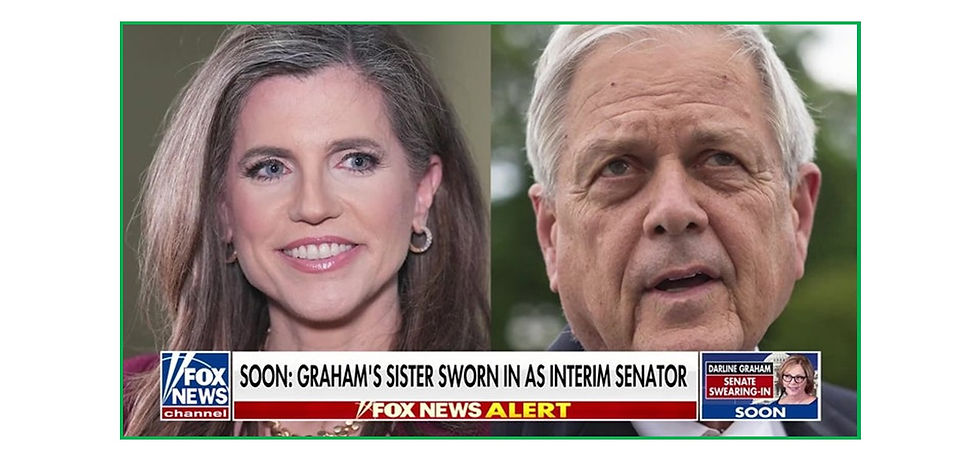
Norman said in a statement to Fox News Digital that he was "honored," to score Mace’s endorsement in the race."Now more than ever, South Carolina needs a PROVEN conservative fighter who will stand with President Trump, advance the America First agenda, and help pass the SAVE America Act in the U.S. Senate," Norman said.
Meanwhile, Graham, who was considered to be a placeholder for the remainder of her late brother’s term, is all-in on running for a full, six-year stint in the Senate.
Trump, after meeting with her in the White House last week, threw his full support behind her, and urged, "run, Darline, run," in a Truth Social post shortly after their meeting.
Graham has so far scored endorsements from key allies in the Senate, including Senate Majority Whip John Barrasso, R-Wyo., who said, "Darline Graham is an excellent senator — she’ll continue to be an excellent senator, and she has my full support."
Darline Graham Nordone speaks during a press conference outside the governor's South Carolina Statehouse office in Columbia, S.C. (Grant Baldwin/Getty Images)
Senate Majority Leader John Thune, R-S.D., however, is staying out of the race for now.
Thune said that Graham is a "strong candidate," and though she lacked elected experience, he noted she was "very accomplished in her own life."
"She has a right, like everybody else, to get in that race," Thune said.
Meanwhile, another South Carolina Republican, Rep. Russell Fry, is also launching a campaign.
Both Mace and Norman went after Fry on Monday, warning that his bid for the Senate could further shrink House Republicans’ razor-thin majority and tip the balance of power in favor of House Minority Leader Hakeem Jeffries, D-N.Y., and Democrats.
Fry can appear for multiple offices on the ballot under South Carolina law, He was unopposed for his primary election for South Carolina’s 7th congressional district, and if he wins the nomination, he’ll be on the ballot twice for both.
Ultimately, he’ll have to choose if he wins both, which would trigger another special election to fill his place. That is not a problem for either Mace or Norman, who both ran and failed to clinch the Republican gubernatorial nomination last month.
"I will never hand Hakeem Jeffries that gift," Mace said on X.
"If you're running for two offices at once, you've already told us who you are," she continued.
"That's not about politics anymore — that's about power. You're either with the people you serve or you're not."
The FOX News
GLOBAL:
OVERTURNED

The Left has a simple goal: Shut down every pro-life center in America. And they're moving faster than you think – aided by taxpayers.
The abortion industry is doing this by colluding with far-Left governments to slander and lie about pro-life centers using a state-funded media campaign and branding them as dangerous to scare women toward abortion.
The Left knows these centers can't compete with taxpayer dollars. This is a blueprint to make abortion the only option, and your state is on the Left's list to attack next.
In Massachusetts, we filed a massive federal lawsuit to stop the use of taxpayer dollars and the weaponization of government against our client – a pro-life center.
Now we're battling that case at the First Circuit Court of Appeals – one step away from the U.S. Supreme Court. And TODAY is the deadline for the state and the abortion industry to respond. The outcome could set a precedent in every state in America, and if we lose, pro-life centers remain vulnerable.
Let me be blunt. The number of babies we can help save will be directly impacted by the resources we can raise to fight back. We represent our clients for free, and taking on a state government with unlimited taxpayer resources requires an immense effort – and that takes your support.
This week we are launching our Defend the Defenseless week, and we urgently need YOU. Have your gift DOUBLED today.
Pro-life centers serve as beacons of light for LIFE in thousands of communities, but they are facing an onslaught of legal and political targeting. Take action with us.
Jordan SekulowACLJ Executive Director
Treasury Stops Nearly $100 Million in Payments to Dead People

The Treasury Department said Tuesday it has blocked nearly $100 million in federal payments from being sent to deceased individuals since implementing a government-wide payment verification process last year.
Since March 2025, the Treasury Department's Bureau of the Fiscal Service has reviewed approximately 885 million payments totaling nearly $2.7 trillion and identified more than 4,900 payments worth about $99 million that were associated with deceased payees, according to the department, the New York Post reported Tuesday.
Treasury said the payments were halted before funds were disbursed, and the payments were returned to the originating federal agencies for further review. The department said payments directed to deceased individuals can be an indicator of fraud or other improper payments.
The $99 million represents about 0.0036% of the $2.7 trillion in payments reviewed, but Treasury said the amount is more than three times the amount identified before President Donald Trump's administration expanded payment verification efforts.
"Treasury has delivered on a key promise of President Trump's mandate to stop improper payments and fraud before money leaves the Treasury, and strengthen the integrity of the federal payment system," Treasury Secretary Scott Bessent said in a statement.
"Together with Vice President Vance's Task Force to Eliminate Fraud, this new safeguard addresses a longstanding vulnerability and helps ensure every dollar the federal government spends reaches its intended recipient," Bessent added. "Treasury will continue efforts to modernize the federal payment system, strengthen safeguards against fraud and improper payments, and protect taxpayer dollars."
Treasury said it used the federal Do Not Pay program, which verifies a recipient's identity, eligibility, and banking information before federal payments are issued, along with additional verification tools to identify improper payments.
The department said it significantly expanded its use of those verification systems last year following directives from Trump aimed at reducing waste, fraud, and abuse in federal spending.
Treasury officials also credited expanded access to the Social Security Administration's Full Death Master File for improving the government's ability to identify deceased recipients. Congress granted Treasury temporary access to the database in 2021, and Trump signed the Ending Improper Payments to Deceased People Act into law in February, making that access permanent.
The department estimates the enhanced verification process will produce about $330 million in net benefits by reducing improper payments made to deceased individuals.
Related Stories:
The News MAX
Trump Eyes New Tariffs as Global 10% Duties Expire

President Donald Trump reportedly plans to impose fresh tariffs on dozens of countries as his 10% global duties prepare to end.
Administration officials have developed plans that would allow Trump to announce new tariffs as soon as this week on roughly 60 countries, replacing the temporary 10% tariff regime set to expire Friday, the Financial Times reported Tuesday.
The new duties would range from 10% to 12.5% and would be imposed through a Section 301 investigation into forced labor practices, rather than the emergency powers the Supreme Court struck down earlier this year, according to the Financial Times.
The move would mark the latest step in Trump's effort to reshape global trade while seeking new legal avenues to protect American industries after the Supreme Court ruled in February that he could not rely on the International Emergency Economic Powers Act to impose sweeping reciprocal tariffs.
The proposed tariffs come after Trump on Monday announced a 50% tariff on certain Canadian goods, including electrical equipment and machinery, using Section 338 of the Tariff Act of 1930.
The White House said the new Canadian tariffs would take effect in 30 days and cover about $20 billion worth of imports.
Canadian Prime Minister Mark Carney pledged to defend Canadian workers and businesses, while Ontario Premier Doug Ford urged Ottawa to respond "tariff for tariff, dollar for dollar."
The Financial Times reported that senior administration officials have privately urged Trump to maintain stability with trading partners and preserve trade agreements negotiated last year that reduced tariff rates.
Some advisers reportedly worry that escalating trade disputes could create economic uncertainty ahead of the midterms.
The administration, however, has continued to pursue multiple trade investigations that could provide legal authority for broader tariffs.
In addition to the forced labor probe, officials are examining excess manufacturing capacity involving major trading partners, including the European Union, China, Japan, India, South Korea, Mexico, Taiwan, Vietnam, and others.
The White House has also tempered some earlier tariff proposals by exempting key consumer products and easing duties on certain steel- and aluminum-related goods.
Last week, the administration announced a 25% tariff on many Brazilian imports following a Section 301 investigation into what U.S. officials described as unfair trade practices.
Trump has long argued that tariffs help protect American manufacturing, reduce dependence on foreign suppliers, and encourage companies to invest and manufacture in the United States.
While critics warn the measures could increase costs for consumers, the administration has maintained that strategic tariffs are essential to restoring fair trade and strengthening U.S. economic security.
The Associated Press and Reuters contributed to this report.
The News MAX
Patrick Bestall’s INPUT:

#1.
China & Canada joined at the hip

Outline of this VIDEO
1:38 How China bought up Canada — and laundered the money
2:59 Why the US blocked China but Canada let it in
4:24 FIPA: how China sues Canada in secret
7:57 What China owns — and the triads in Vancouver
9:48 Canada's banks as money-laundering machines
12:00 Globalists vs sovereign nations: the real power game
14:56 China's pincer: using Canada to reach America
18:45 Terror money and Canada's dark side
19:36 The "unity party" and Mark Carney, City of London puppet
23:06 The reverse Opium War: fentanyl as chemical warfare
30:23 Mass immigration and the Great Replacement
40:34 Trump's endgame: China as a bargaining chip
45:59 Tariffs and breaking Canada's dairy cartel
52:33 Why the EU "escape route" is a trap
Other’s Comments:
1. He's right about Chinese influence in Canada, our government is controlled by Chinese dirty money. Ask Sam Cooper, he's been reporting on this for years.
2. How the UN and globalist’s are owning us. They’re replacing us by drug fatalities & mass migration.
3. Carney and the rest of his cabinet are TREASONOUS!
.PB
#2.
Court strikes down Ontario Highway Billboard Ban

SUDBURY, ON: The Justice Centre for Constitutional Freedoms announces that the Ontario Divisional Court has ruled that the Ontario Ministry of Transportation violated the Charter rights of George Katerberg by preventing him from displaying a political billboard criticizing government officials’ response to Covid.
.PB
#3.
How Carney made sure General Dynamics got the 2$B contract

Speaking in London, Ont., Carney said the deal would ensure Canada’s Armed Forces receive the equipment they need while strengthening its industrial base.
Carney has handed a nearly $2 billion military vehicle deal to the Canadian subsidiary of a U.S. defense giant despite pledging to prioritize domestic suppliers and end Canada’s military dependence on the United States.
.pb comments: I didn't know that General Dynamics is a US company.
Don’s input:
Days after defending a ban on U.S. bidders for a $4.9 billion vehicle contract, Ottawa announced a $2 billion deal with an American supplier.
.PB
#4.
ALBERTA FACT CHECK
Alberta's critics were out in force today — a Trudeau senator, a Quebec First Nation, and Ottawa itself — and every lecture collapsed the moment you checked the facts.
First, Trudeau-appointed Senator Paula Simons told a B.C. podcast that independence supporters — a quarter of Albertans — are a "tiny minority" who are "narrow and scared."
Yet in 2013 she called senators "political cronies" and "rabid partisans," then took the appointment. When the federal trough calls, the principles vanish.
Next, a Quebec First Nation joined the pile-on, slamming Alberta's referendum. The catch? The Cree Nation of Nemaska is itself negotiating a self-government deal with Ottawa — and has collected more than $100 million in federal funding along the way. They demand for themselves exactly what they deny Alberta.
Finally, Ottawa advanced Bill C-13 rules forcing Edmonton's banks, telecoms and grain millers — some of the province's biggest employers — to actively provide French services in an overwhelmingly English-speaking province. Albertans didn't ask for this, but Ottawa is handing them the compliance bill.
Let's set the record straight.
The Alberta Fact Check Team


July 20, 2026 | By Sheila Gunn Reid
The federal government is moving ahead with regulations that would force major private-sector employers in Edmonton to actively provide services in French, despite Alberta being an overwhelmingly English-speaking province

July 20, 2026 | By Sheila Gunn Reid
Whether one agrees with Alberta independence or not, there is an obvious political inconsistency worth noting: a First Nation that is itself negotiating greater autonomy and self-government with Canada is criticizing Albertans for exercising a democratic process to consider their own constitutional future.

July 20, 2026 | By Cory Morgan
On a B.C. podcast, Senator Paula Simons dismissed the independence movement as naïve and called it a tiny minority, while acknowledging it represents at least a quarter of Albertans.

July 17, 2026 | By Cory Morgan
Provinces won’t expand East-West infrastructure when they will take a loss on such endeavours. That’s why the federal plan is to offer “incentives,” which of course means selective subsidies and putting pressure on provinces in other ways to “encourage” them to build in regions they wouldn’t normally have.

July 17, 2026 | By Sheila Gunn Reid
Alberta continues to attract record levels of private investment, leads Canada in economic growth, produced nearly 80% of the country's job growth over the past year, and is now becoming a destination for some of the world's largest AI infrastructure projects.

July 17, 2026 | By Sheila Gunn Reid
Meta has committed $13 billion, nearly 100 other data-centre proposals are reportedly in the pipeline, and another developer is now pitching a one-gigawatt project near Edson. Investors are not running from Alberta. They appear to be forming a queue.

July 17, 2026 | By Cory Morgan
The Calgary Chamber of Commerce, headed by writer Deborah Yedlin, has been releasing almost apocalyptic predictions for Alberta’s future due to the upcoming referendum.
.PB
#5.
New International AI Alliance

I missed this last month.
Take the TIME to VIEW this VIDEO... TX PB
RELATED
.PB
#6.
A Novel Gage of Anxiety among the Elite
The system compares the number of aircraft in the air with activity recorded during similar historical periods before assigning its alert level.
Level 1 indicates normal activity, while Level 5 represents an exceptional spike measuring five standard deviations above the baseline.
That threshold is intended to prevent routine increases caused by holidays, major events or ordinary changes in travel from repeatedly triggering the alarm.
McDonald cautioned that even a Level 5 reading would not prove that billionaires were fleeing an impending disaster.
.PB
#7.
Oil Supply

43 Days And Counting: Apathetic Americans Are About To Be Blindsided By A Major League Wake Up Call [Excellent Overview]

.PB
#8.

Are You Prepared For The Coming Economic Collapse And The Next Great Depression?
43 Days And Counting: Apathetic Americans Are About To Be Blindsided By A Major League Wake Up Call

.PB
INTERESTING ITEM:
OAK Centre
THE OAK CENTRE BULLETIN
July 21, 2026
Where there is no vision, the people perish.
But whoever obeys the law is joyful.
Christ and Culture
The Oak Centre exists to facilitate deep Christian thought and engaging conversation across a variety of traditions and disciplines. We aspire to equip Christian educators, scholars, pastors and ministry leaders with the resources, networks, and intellectual communities needed to shape culture with wisdom and clarity. Through curated collections, thoughtful programming, and a culture of hospitality, the Oak Centre serves as a networking node and resource hub for Christian influencers who seek to bring the truth of the Gospel to bear on all areas of life.
We work within a broadly based Kuyperian tradition, with deep roots in the many Reformed traditions. beyond that, we claim the rich tapestry of Christianity, going back two thousand years, as our inheritance. Steve Bishop’s magisterial biography, Kyper: A Primer (2025), takes almost 600 pages just to map out the scope of Kuyper’s life’s work. And Bishop’s study should be read alongside Craig Bartholomew’s Contours of the Kuyperian Tradition: A Systematic Introduction (2021). This is rich soil within which to plant an initiative like the Oak Centre.
But there is more. The Oak Centre is also favoured by its location in Hamilton, at the centre of an extensive Christian educational ecosystem that extends throughout our region. Much of this ecosystem has been built by the post-war Dutch immigration to this part of Ontario in the 1950s and 1960s. If there were a region primed for a revival of a reformed worldview for all of life, powered by the Holy Spirit, it is here. See my working document, Mapping the Christian Educational Ecosystem in the Golden Horseshoe.
What’s with Christian Nationalism?
The Christian Courier has taken up this topic with an extensive set of articles, over the past few years, all with a very dark view of “Christian Nationalism.” The perspective in many of these studies runs parallel to the New York Times bestseller Jesus and John Wayne: How White Evangelicals Corrupted a Faith and Fractured a Nation, by Kristin Kobes Du Mez. The Presbyterian Church of Canada has jumped into the fray with a warning about The Church and Christian Nationalism that touches all the hot-button issues.
In the US. Amanda Tyler’s How to End Christian Nationalism (2024) has had a wide circulation, and Michael W. Austin’s American Christian Nationalism: Neither American nor Christian beats on the same drum.
On the other hand, First Things has published articles such as R.R. Reno “The Case for Christian Nationalism”; Josh Hawley, “The Christian Nationalism We Need”, and Peter Leithart, A Better Christian Nationalism.’ Clearly, much hinges on what is meant by the term “nationalism.” Would those who warn in such dark terms about the evils of Christian Nationalism have similar misgivings about T. S. Eliot’s Idea of A Christian Society (1939) or R. R.
Reno’s Resurrecting The Idea of a Christian Society (2016)? Clearly, much remains to be sorted out here.
Our September Inklings Conversation will feature David Millard Haskell,
Associate Professor, Digital Media and Journalism / Religion and Culture at Wilfred Laurier University, speaking on his important new book, Christ or Collapse: The Case Against Godless Government (2026). David’s pioneering work provides a valuable framework for reflections on a wide range of issues now confronting the Christian community.
Our Inklings Conversation for July brings us to the heart of Christ’s worldview and teaching on same-sex relationships. Jordash has conducted groundbreaking research on this topic, and his book is unique in the world of scholarship. Plan to join us this Thursday.
Inklings Conversation
with Jordash Kiffiak
Thursday, July 23rd, 2:00 - 4:00 PM EST
Jesus and Sodom: A Detailed Look at Jesus’s View on Same-Sex Relationships
Speaker Bio
By profession, Jordash is an instructor, biblical scholar and author. He spent eight years studying the Gospels at the Hebrew University of Jerusalem and received his PhD there in 2013. During this period, Jordash gained a high level of proficiency in the three biblical languages (Hebrew, Aramaic, and Greek).
He is in the process of completing a book entitled Jesus and Sodom: Same-sex Sexuality through the Messiah’s Merciful Eyes, which looks at Jesus’ traditional view on homosexuality and his call to repentance and hope for profound change in the New Covenant. The book is being published chapter by chapter on Substack. (Sixteen have been published thus far.) In this conversation, Jordash will highlight the research’s findings. Jordash is deeply grateful to God the Father, whom he credits for the courage and understanding he has received to write this book.
This summer, Jordash has launched a new educational initiative called King Jesus, Greeks and Romans that re-examines the foundations of Western civilization to help individuals achieve clarity and alignment with their ultimate values through a historical understanding of the positive and negative developments in Western society.
Conversation Abstract
One of the most pressing challenges facing the Body of Christ today is how to faithfully understand and believe what God’s Word says about marriage and immorality—particularly same-sex sexuality.
The Old Testament is unambiguous: homosexuality is sin. Paul, the apostle of Jesus, teaches the same. Yet in our time, these clear teachings are increasingly questioned. Some reinterpret the biblical texts, while others set aside Leviticus and Paul in favour of a supposed “love ethic” that affirms homosexuality as something good. This shift is happening not only in historic mainline denominations, but also in many evangelical congregations. At root is a deeper issue: how is the authority of Scripture to be viewed.
However, even among “progressive” Christians, there is often a noticeable pause when the focus turns to Jesus. And rightly so. If He is Lord of all, then those who claim to follow Him have every reason to move carefully and do the hard work of discovering what He actually believed and taught.
So, what did Jesus think about homosexuality? In his book, Jordash carefully examines this question from many angles. He explores Jesus’ broader teachings on marriage and sexual immorality—with special attention to the sins of Sodom. His conclusion is clear: Jesus held the traditional Jewish view on same-sex sexuality. At the same time, He is exquisitely merciful. He freely offers forgiveness and the transforming power of the Holy Spirit to all who come into covenant with Him.
From personal experience, Jordash has observed how a weakened conscience can develop—even among biblical scholars—when we stop reading God’s Word for personal transformation. What was once clearly understood as sin gradually becomes tolerated, then embraced, and eventually celebrated. The remedy is straightforward: we must return to the Scriptures with the same reverence that Jesus exhibited during his earthly ministry. Echoing through the centuries, Christ’s invitation still stands: “Take my yoke upon you and learn from me; for I am gentle and humble of heart, and you will find rest for your souls” Matt. 11:29.This invitation holds even for our generation of sexual confusion and turmoil.
For Further Reading
Biblical Context
Richard M. Davidson, Flame of Yahweh: Sexuality in the Old Testament (2007); Donald J. Wold, Out of Order: Homosexuality in the Bible and the Ancient Near East (1998); Michael L. Brown, Can You Be Gay and Christian? Responding with Love and Truth to Questions about Homosexuality (2014).
Current Setting
Anne Gillies, Damaged by the Predators Among Us (2022);
Anne Gillies, Closing the Floodgates: Setting the Record Straight about Gender and Sexuality (2019), Rosaria Butterfield, Five Lies of Our Anti-Christian Age (2023),
Lament for a Nation by the Numbers
To lament is to cry out at the death or at the dying of something loved.”
G. Grant, Lament for a Nation (1965). Grant’s lament mourned “the end of Canada as a sovereign state.”
Those of my generation can well remember the joy and pride of being Canadian at the celebration of our Centennial in 1967. How quickly things changed with the election of the first Trudeau in 1968, culminating in the dysfunctional administration of his son, Justin, who famously declared: "There is no core identity, no mainstream in Canada,” and, consequently, that Canada was “the first post-national state.” The New York Times Magazine, December 2015. The poverty of this vision has left Canadians in a sorry state.

The numbers do not look good, and at this point, 42% of Canadian manufacturing companies are considering moving their businesses to the United States. A KPMG survey of Canadian producers shows that 77% of those Canadian companies considering a move plan to do so within the next two years. As J.B Shurk notes in his July article, Hubris Sinks Canada, “Companies cited Canada’s expensive ‘green energy’ regulations, burdensome corporate taxes, and government restrictions on capital investment as major reasons for fleeing Canada’s centrally controlled economy. “ This is not good, and it gets worse.
As Shurk notes here, unfortunately, Canada is filled with America-haters whose arrogance prevents them from recognizing the fragile state of their economy. The U.S. Ambassador to Canada, Pete Hoekstra, has tried to warn ungrateful Canadians of their folly, but to no avail. As Shurk wryly observes, “Economic growth through economic suicide is the Canadian way.” As this scenario unfolds, 75% of Canada’s economy is now based on trade that is uncertain. The future for Canada as a sovereign nation looks very unpleasant.
Because the Canadian government controls the news media, Canadians falsely believe Canada is independent and strong. This could not be further from the truth, and this hubris will soon lead to the painful discovery that Canada is dependent and very weak. We have done this to ourselves, and there is reason indeed to lament our folly.


Faith Lost is Culture Lost
Christopher Dawson delivered the 1948-1949 Gifford Lectures in the wake of World War II. These lectures were subsequently published in 1950 under the title Religion and the Rise of Western Culture. It is a profound study, and the converse has proven true. Maryann Keating explores this development in her essay earlier this year in the National Catholic Register under the sub-title, Christopher Dawson’s Prophetic Warning. Dawson was prescient on such matters, and his work merits careful study.
It is not without some irony that Dawson finished his career in the Department of Religion at Harvard University—an institution that long ago traded VERITAS (truth) for DEI and now runs a well-oiled “Discrimination Machine,” as Christopher Rufo documents in his City Journal article. In today’s Harvard, a scholar of Dawson’s eminence and convictions need not apply.

The Lure of Marxism
70% of millennials prefer socialism over capitalism, and most have a benign view of communism, despite the documented horrors in the last and this century committed in the name of that ideology and its variants. See The Black Book of Communism (1999) for starters. Such rootless souls, with zero historical knowledge, will embrace a charlatan like Zohran Mamdani. The fact that the leadership of the Democratic Party is falling over itself to cling to the coattails of this fraud is a sorry spectacle.
This state of affairs harkens back to the 7 Levels of Stupidity outlined by
Kevin Finn in the American Thinker and summarized in the May Oak Centre Bulletin. In his analysis, Finn shows how “Stupidity can evolve from a personal flaw into a civilizational threat.” Here, we are getting dangerously close to a tipping point. where ignorance, born of affluence, has infested half of Gen Z.
G. North, Marx’s Religion of Revolution: The Doctrine of Creative Destruction (1968) would be a good place to start if one wished to understand the true nature of Marxism. Note: the whole book is available electronically from the above hyperlink.
The Work of the Oak Centre
From a secular perspective, the vision of the Oak Centre may seem wildly unrealistic; however, from a Christian point of view, the significance of a venture is never measured by what we can see on the surface; rather, its significance is to be measured by the vision we bring to it with the eyes of faith. In this vision, we see the Oak Centre as a hub of influence and a place for important conversations, locally, regionally, and globally.
Our image is apt. A small acorn planted and watered by faith can grow into something very substantial over time. In Scripture, we are exhorted to “despise not the day of small things”, but to see things through “the eyes of God who ranges over the whole earth” –through all of history (Zech. 4:10). In our view, God’s faithfulness is to all generations, making the study of the whole history of the Church in its engagement with culture vitally important.
Located in St. George’s Anglican Church near McMaster University, The Oak Centre is dedicated to revitalizing Christian intellectual and moral leadership at the heart of Canadian culture since 2019. We aim to achieve this by aligning ourselves with an emerging network of Christian thought leaders in Canada and around the globe and by making available the best that has been thought and lived through the two thousand years of Christian history and the two thousand years of Jewish history that preceded it.
The Three Facets of the Oak Centre
From its inception, the work of the Oak Centre has been organized around three main facets:
(1) Creation of an organizational structure to foster deep study and conversation on matters of faith, vocation, and culture. Link with other Study Centres, such as the Consortium for Christian Study Centers.
(2) Develop a physical home and meeting space to carry out the vision of the Oak Centre through in-person and online meetings
(3) Curation of a unique collection of Christian and Jewish sources, scholarship, and learning, and provide physical and digital access to this material.
All three aspects have undergone various stages of development over the past seven years, culminating in the relocation of the Oak Centre from downtown Hamilton to its current location at St. George’s Anglican Church in the west end of the city, near McMaster University.
The link here provides a glimpse of the progress made toward establishing the Oak Centre study and meeting space at St. George’s Church. It is our intention to house the essential resources for Christian formation in the service of bringing every thought captive to the knowledge of Christ. An important document in this folder includes the Project Scope for a comprehensive Network Implementation at St. George’s.
The link here shows the variety of Conversations we have hosted over the past years. For a look at some of the resources we are curating and have catalogued, please click here. For an overview of one of our collections: the Beverley Collection, please click here. A significant portion of the Beverley Collection is indexed but in storage. Plans are under consideration to move key sections of this collection along the east wall of the study space at St. George’s.
Meet The Oak Centre Advisory Board
The Oak Centre has an Advisory Board of 7 members: Gerry de Koning (Toronto), chair of our board, Harold Klassen ( Abbotsford, BC), George Durance (Oregon), Stanley Carlson-Thies (Washington, D.C.), Joshua Arp (Scranton, PA), The Rev. Paul Luth, Minister of St. George’s (Hamilton), and Sevda Linda (Hamilton), Inter Varsity, Campus Minister, McMaster University.
This current Advisory Board has been brought together over the past year and a half to help shape a long-term development strategy for the Oak Centre at its new location. Not all the active links are formal profiles for Advisory Board members, but they provide a glimpse of the team working with me on the development of the Oak Centre.
I will include Sevda’s remarkable testimony from her conversion at age 16 in her hometown of Ganja, Azerbaijan, to her ministry with students at McMaster in the August Bulletin. This Bulletin will also focus on the unique opportunities and challenges for ministry at McMaster University.
How Can I Support Oak Centre
Since its inception, the Oak Centre has operated on a shoestring budget through the volunteer efforts of its founding members. We have kept operating costs to a minimum while preparing for seed funding and foundation support to enhance our operations and expand our influence. Much of our work has been preparatory for this next stage of development. Every donation, however modest, makes a big difference.
Through our close working relationship with TeachBeyond, the Oak Centre can issue tax receipts for all donations, and this relationship has been essential and highly effective at this stage in the Oak Centre's development.
Donations can be made as a one-time gift or as a recurring monthly gift.
Grace and peace,
Donald McNally
President Emeritus, NetAccess Systems
Founding Director, the Oak Centre for Studies in Faith and Culture
21 King St.West, Suite 1600-B, Hamilton, ON L8P 4W7
Tel: 289-426-2495 Mobile 905-570-3006
The OAK CENTRE
SPACE requires that I do the RUMOUR SECTION in [PART TWO]
Please go to PART TWO

![SATURDAY [Part-ONE]](https://static.wixstatic.com/media/7f1dc1_75127e5e21d845f2a1d5bb9cdda5b909~mv2.jpg/v1/fill/w_980,h_692,al_c,q_85,usm_0.66_1.00_0.01,enc_avif,quality_auto/7f1dc1_75127e5e21d845f2a1d5bb9cdda5b909~mv2.jpg)
![SATURDAY [Part-TWO]](https://static.wixstatic.com/media/7f1dc1_93e735cae30f4f0fb9a3cdab332ff0c7~mv2.jpg/v1/fill/w_980,h_980,al_c,q_85,usm_0.66_1.00_0.01,enc_avif,quality_auto/7f1dc1_93e735cae30f4f0fb9a3cdab332ff0c7~mv2.jpg)
Comments