FRIDAY [PART-ONE]

New BLOG – Great ARTICLES
FRIDAY 9 -[18]-26
PART-ONE
SPIRITUAL:
Sermon on Evangelism

This is one of the best sermons that I have heard dealing with Evangelism.
John Hood, Eastwood St. Thomas "Do not Lose Heart in your Evangelism" (2 Cor. 4:1-6)
David Herbert <daherbert77@protonmail.com>
In Him,
David Herbert
Verse-for-TODAY:
New International Version
Do nothing out of selfish ambition or vain conceit. Rather, in humility value others above yourselves, not looking to your own interests but each of you to the interests of the others.
Read all of Philippians 2 ►
Our God is an awesome God !

There are umtine number of opinions, as to when the rapture, etc., etc. will happen, so it has become commonly considered as a matter of opinion.
Kent Christmas, is indeed a prophet of "HIS" Heavenly word. For this latest broadcast,( the video below) I think you had better put your "seat belts" on.
Always in His service,
Fred
[ONE OF THE MOST IMPORTANT PROPHECIES OF THE YEAR] END OF 2026 Kent Christmas Prophecy Sep 16, 2026. Pastor Kent Christmas shared this powerful prophetic word Friday during Open the heavens conference 2026 Sep 11, 2026
The Lord's Fall Appointed Times


There’s something special about the changing of the seasons.
The air becomes cooler. The days grow shorter. The harvest is gathered. And once again, the biblical calendar brings us to a remarkable season—the fall appointed times of the LORD.
These are more than dates on a calendar.
They are appointments with God.
In Leviticus 23, the LORD calls them His appointed times—holy convocations established according to His calendar and His purposes. Each year they invite us to stop, remember, worship, and consider the unfolding story of redemption.
And for followers of Yeshua, these days carry an especially powerful message.
The spring feasts beautifully reveal Messiah’s work of redemption—His sacrifice, resurrection, and the giving of the Spirit. The fall feasts turn our attention toward themes of awakening, repentance, judgment, restoration, the return of the King, and ultimately God dwelling with His people.
As the fall feasts arrive in 2026, perhaps the most important question isn’t simply:
“What day is it?”
Perhaps the deeper question is:
“What is the Lord calling me to remember?”
YOM TERUAH — THE DAY OF TRUMPETS
September 12, 2026
Began at sundown September 11
“In the seventh month, on the first day of the month, you shall observe a day of solemn rest, a memorial proclaimed with blast of trumpets, a holy convocation.”— Leviticus 23:24
The fall appointed times begin with a sound.
The trumpet blasts.
Throughout Scripture, the trumpet can announce something important: a gathering, a warning, the approach of battle, or the arrival of a king.
It is a sound meant to get our attention.
And perhaps that is exactly where our fall journey should begin.
Wake up.
Life has a way of slowly distracting us. Responsibilities multiply. Schedules become crowded. The voices of the world become loud. Without realizing it, our spiritual hearing can become dull.
Then comes the trumpet.
Yom Teruah reminds us that God’s people are called to live awake and watchful.
For believers in Messiah, the imagery is difficult to miss. Scripture connects the future coming of Messiah with the sounding of a trumpet. The King who came first as the suffering servant will come again in glory.
So when the trumpet sounds, we remember:
Our King is coming.
Are our hearts ready to meet Him?
YOM KIPPUR — THE DAY OF ATONEMENT
September 21, 2026
Beginning at sundown September 20
Ten days after Yom Teruah comes the most solemn of the LORD’s appointed times: Yom Kippur—the Day of Atonement.
Leviticus 23:27 calls God’s people to humble themselves before Him on this day.
There is a beautiful progression here.
First comes the trumpet:
Awaken.
Then comes the invitation:
Return.
Yom Kippur confronts us with the seriousness of sin, but it also reminds us of the extraordinary mercy of God.
Under the Torah, the high priest entered the Most Holy Place with sacrificial blood to make atonement for the people.
For followers of Yeshua, this imagery points powerfully toward Messiah.
He is our great High Priest.
He did not enter with the blood of another sacrifice. He offered Himself.
Because of Him, forgiveness is not merely something we hope for—it is something God has provided through the Messiah.
Yet grace should never make repentance unnecessary.
Grace should make repentance irresistible.
This season gives us an opportunity to ask the Lord:
Search me.
Is there bitterness I have allowed to remain?
Is there someone I need to forgive?
Is there something I need to confess?
Have I slowly drifted away from wholehearted obedience?
Yom Kippur reminds us that the God who calls us to repentance is also the God who has made a way for reconciliation.
SUKKOT — THE FEAST OF TABERNACLES
September 26–October 2, 2026
Beginning at sundown September 25
Then something wonderful happens.
The solemnity gives way to joy.
Sukkot, the Feast of Tabernacles, remembers the time Israel lived in temporary shelters during the wilderness journey and depended upon the LORD for provision.
God provided their food.
God provided their water.
God guided their steps.
And most importantly:
God dwelt among them.
That is the heartbeat of Sukkot.
God dwelling with His people.
Think about how magnificent that theme becomes as the story of Scripture unfolds.
The God who dwelt among Israel desires to dwell among His people.
Messiah came and “dwelt” among us.
Through His Spirit, God now dwells within His people.
And Scripture points toward the glorious day when God’s dwelling will be with humanity in its fullness.
Sukkot therefore teaches us something our culture desperately needs to remember:
Our security is not found in what we possess.Our security is found in the One who dwells with us.
A sukkah is temporary.
So is everything else in this world.
Our houses are temporary.
Our possessions are temporary.
Our earthly bodies are temporary.
But the Kingdom of God is not temporary.
Sukkot invites us to loosen our grip on the temporary and rejoice in the eternal.
SHEMINI ATZERET — THE EIGHTH DAY
October 3, 2026
Beginning at sundown October 2
After seven days of Sukkot comes one final appointed gathering:
Shemini Atzeret—the Eighth Day.
There is something beautiful about this final day.
After the trumpet has sounded…
After hearts have been humbled…
After the people have rejoiced before the LORD…
God calls His people to remain with Him for another appointed assembly.
It brings the fall feast season to a beautiful conclusion.
And the imagery points our hearts toward the great destination of God’s redemptive story:
God and His people together.
From Genesis to Revelation, this has always been the desire of God.
He walked with Adam and Eve in the garden.
He dwelt among Israel.
He came among us through Messiah.
He dwells within His people through His Spirit.
And Scripture ends with the magnificent promise that the dwelling place of God will be with humanity.
The biblical story is moving somewhere.
And the destination is not merely people escaping earth to be with God.
It is God dwelling forever with His redeemed people.
Don’t Just Mark the Dates—Meet With Him
The fall feasts give us a remarkable progression:
Yom Teruah:
AWAKEN — The trumpet is sounding.
Yom Kippur:
RETURN — Humble your heart before God.
Sukkot:
REJOICE — Remember His provision and presence.
Shemini Atzeret:
DWELL — Look toward eternity with the King.
Maybe this year these days can become more than information.
Maybe they can become an invitation.
An invitation to turn down the noise.
To open the Scriptures.
To gather your family.
To pray.
To repent.
To forgive.
To rejoice.
To remember what God has done.
And to renew our longing for what He has promised yet to do.
The world around us may be uncertain, but God’s redemptive plan is not.
The King is coming.
And one day, the temporary will give way to the eternal.
Until then, may we be a people who are awake, faithful, expectant, and ready.
Come, Lord Yeshua.
May these appointed times draw us deeper into God’s Word, closer to Messiah, and into greater anticipation of His coming Kingdom.
Much Love from Ontario, Canada,
Ronna a.k.a. Faith Walker
Mission Discipleship
For a deeper dive into the study of the prophetic significance of the Feasts of the Lord CLICK HERE and download our Jewish Roots of Christianity Bible Study
CANADIAN:
Carney's 'new world order' talk, Trump calls Canada-EU partnership 'Hostile’!

Carney Says Canada and E.U. 'Are Not Fair Weather Allies' as Trump Threatens Europe Over 'Hostile Act'
Short Summary — Key Points [ChatGPT]
Prime Minister Mark Carney welcomed the idea of Canada developing an unprecedented “associate member” relationship with the European Union, arguing that Canada and Europe are stronger through deeper cooperation.
The initiative comes amid a serious Canada–U.S. trade dispute, with Canada seeking to reduce its economic dependence on the American market.
Carney emphasized trade, defence, critical minerals, AI, energy security, space and financial systems as major areas for closer Canada–EU integration.
President Donald Trump criticized the proposal and warned that the U.S. could impose heavy tariffs on Europe if he viewed the arrangement as hostile.
Canada has also applied to join the U.K.-led Joint Expeditionary Force, further expanding its European defence relationships.
Importantly, the arrangement is not yet a defined form of EU membership. Carney says the eventual structure will be debated and voted on by Canada's Parliament, while further negotiations are expected around the Canada–EU summit in Montreal in late October.
Bottom line: Canada is exploring a significantly deeper strategic relationship with Europe while trying to diversify its trade and security partnerships beyond the United States. Exactly what “associate membership” would mean—and how far the relationship will go—remains to be negotiated.

Comment:
I don't think a single citizen has asked for Canada to join the EU. We are Americans; we live in North America. Right now, I firmly believe that PM Carney is going too far in his trade war with the USA—or is the PM trying to foist his globalist propaganda on us? I hope not.

RUMBLE News
What joining the EU would really mean for Canada

Joining the EU as an “associate member” may represent the greatest existential threat to Canada thus far.
Short Summary [ChatGPT]
The article argues that a closer Canada–EU relationship may offer trade, investment, labour mobility, study opportunities and technology cooperation, but warns that deeper integration could come with significant costs to Canadian sovereignty. It notes that Canada already has the CETA free-trade agreement and argues that expanding energy exports—particularly oil and natural gas—could increase European trade without requiring EU-style membership.
Its main concerns are that a deeper arrangement could eventually expose Canada to EU immigration rules, financial contributions, regulatory requirements and greater influence from Brussels over domestic policy. The article specifically points to European migration policies and Carney's reference to possible “enhanced labour mobility.”
Bottom line: The author's position is that Canada should strengthen economic and strategic cooperation with Europe, but without surrendering Canadian control over immigration, taxation, regulation or national decision-making. Sovereignty—not trade—is presented as the central issue.
[ChatGPT]
Judge Rejects Request to let Tamara Lich Travel Internationally for Work

Last night, on The Ezra Levant Show, Tamara Lich’s sentence-variation hearing ended, but she still doesn’t have a standing right to work in the United States.
Lich had asked to travel south for Rebel News work, while the Crown opposed the request and sought tighter restrictions. The judge left the core conditions in place, meaning international travel remains possible only through individual applications, while her house-arrest period is nearly over and her curfew remains.
Ezra explained the decision, the battle over Lich’s U.S. travel and why Rebel News believes Lich belongs on its board.
REBEL News
TRUMP:
7 takeaways from the stunning new Project South allegations
New information was released about the Toronto police corruption allegations following a court application by the Star and other media outlets.
Sept. 17, 2026

Toronto Police Service Chief Myron Demkiw speaks during a press conference announcing the Project South results in early February.
Jon Blacker/The Canadian Press
Investigative Reporter, and
New information related to the Project South investigation was released Wednesday and it includes shocking allegations of police corruption and criminality by several Toronto officers.
Released to media organizations by court order, the new details are contained in a document known as an information-to-obtain, or ITO, filed by police in January in order to obtain search warrants for key suspects.
The 274-page document, some of which remains under publication ban, provides fresh insight into the months-long probe led by York Regional Police and shows how one of the biggest police corruption scandals in Toronto history grew from an investigation of an attempted murder of a jail official.
The new information highlights both the severity of the alleged misbehaviour — selling confidential information to accused criminals and drug dealing between officers — but also how casually the officers allegedly carried out the offences.
It also shows how the more Project South investigators dug, the more they found.
Here are seven key takeaways from the latest development:
These are unproven allegations
None of the allegations from the ITO have been proven or tested in court. The information includes evidence gathered by police and presented to a judge in order to be granted search and arrest warrants for the suspects charged in February.
The probe netted a total of 28 people, including seven Toronto police officers and one retired constable, but investigators had even more officers and civilians under surveillance. Several who have not been charged were subject to search warrants.
Seven Toronto police officers and one retired constable have been charged in the massive Project South investigation.
Police used surveillance, wiretaps, hidden recording devices and undercover officers to gather evidence
The ITO includes many more details than were previously known of the tactics Project South investigators used to gather evidence.
In addition to physical surveillance, they also wiretapped suspects’ phones, hid recording devices in their vehicles, recorded outgoing jailhouse phone calls, and on at least two occasions carried out undercover operations.
Hundreds of officers from three different police services, including Toronto and the Ontario Provincial Police, contributed to the investigation. Correctional services staff and a team of federal and provincial prosecutors were also involved.

The Project South Files
The Project South Files
The Project South Files
The alleged corruption is worse than previously known
At the February news conference announcing the arrests of seven Toronto police officers, police Chief Myron Demkiw called it a “painful and unsettling moment.”
The new details released Wednesday show that the alleged corruption within the city’s police force is even worse than what was described five months ago.
It is not just a single rogue cop, but a coterie of allegedly corrupt officers who appeared to have little fear of being found out, given how openly they discussed the allegedly criminal behaviour with their colleagues.
Timothy Barnhardt is the nexus of the investigation
At the centre of Project South is veteran Toronto cop Timothy Barnhardt.
When York police began investigating the attempted murder of the jail official, they traced a search of the official’s licence plate to Barnhardt, who had allegedly queried the Ministry of Transportation database on an off-day.

Timothy Barnhardt
Alexandra Newbould for the Toronto Star
From there, police said they found 17 off-duty searches by Barnhardt in a six-month period, all of which they considered suspicious. They later connected many of those searches to shootings. Targets included the residences of people who had gambling debts with organized crime groups, a witness to a murder and a jeweller who was the victim of an attempted robbery outside his store.
Police allege Barnhardt was “routinely” paid by alleged drug trafficker Brian Da Costa to conduct the searches.
In August 2025, a wiretap of Barnhardt’s phone recorded him speaking to an associate about how he was paid to run “surveillance checks” — usually for around $500 per week, he said, according to the ITO.
One of Barnhardt’s lawyers, Jason Dos Santos, told the Star in an email that they will defend the allegations in court “where facts — not headlines — decide the outcome.”
Once Barnhardt was under surveillance, the scope of Project South expanded dramatically. Police began collecting evidence of Barnhardt’s alleged connections to organized crime, and other officers were soon swept up in the dragnet.
Select transcripts remain under publication ban
Transcripts of select recordings in the case will remain under a court-ordered publication ban after Superior Court Justice Laura Bird ruled the comments would “deeply offend” the public and could risk the accused’s rights to a fair trial.
The dialogue allegedly took place between Barnhardt and Da Costa, while being covertly intercepted in September.
“During their conversation, Mr. Barnhardt said things that would rightly deeply offend members of the public,” Bird wrote in her decision. “The comments attributable to him are made worse because he was sworn to uphold the safety of the public but demonstrated a complete indifference to extreme violence.”
While Bird highlighted the importance of public scrutiny in the case, she found the comments could not be made public, as “they could create an indelible impression of guilt in the mind of potential jurors that would be extremely difficult to dispel.”
Drug dealing between officers
The ITO includes several alleged instances when Barnhardt and other Toronto police officers are observed or overheard buying, selling or discussing drugs with each other.
Investigators describe it as an “organized, multi-level drug trafficking operation” involving Toronto police officers.
Barnhardt was observed allegedly selling cocaine to another 12 Division constable, Saurabjit Bedi.
After parting ways following one meetup, the court documents describe Bedi calling Barnhardt to ask if he “looked f — ed” when Barnhardt saw him because he was on his way to pick up his kid from daycare.
Barnhardt told him to put sunglasses on. “You got … what do they call them … cocaine eyes.”
Cops discussed taking “envelopes” to protect illegal dispensaries and massage parlours
The ITO also includes allegations that Barnhardt and several other officers openly discussed taking bribes — or “envelopes” — in exchange for providing police protection to black-market cannabis dispensaries and erotic massage parlours they planned to operate.
The warrant documents say the illicit businesses never opened, but investigators allege Barnhardt and Da Costa took steps to “plan, finance, and operate” them with the help of several Toronto police officers.
“When all three (dispensaries) are open, we buy the bare minimum of government weed, we keep all on display … then on the back shelf it’s all the homegrown stuff,” the ITO quotes Barnhardt telling his former police partner.
A lawyer for Da Costa declined to comment.

Brendan Kennedy is a reporter on the Toronto Star’s investigative team. Reach him via email: bkennedy@thestar.ca

Abby O’Brien is a Toronto-based general assignment reporter for the Star. Reach her via email: abbyobrien@thestar.ca
The TORONTO STAR
Federal probe of Ilhan Omar reportedly targets her father's immigration paperwork, not her marriage

By
A federal investigation into Rep. Ilhan Omar's immigration history is focused less on whether she married her brother and more on how she became a U.S. citizen, raising the prospect of a denaturalization fight that could strip her of citizenship altogether.
Immigration officials who spoke to the New York Post said the Trump administration's inquiry most likely centers on paperwork filed by Omar's father, Nur Said Mohamed Elmi, when the family sought citizenship, not on her 2009 marriage to Ahmed Elmi, the man long rumored to be her brother. Three sources with direct knowledge of immigration enforcement laid out why: the marriage fraud angle is legally dead, but the naturalization angle could still carry consequences.
Department of Homeland Security Secretary Markwayne Mullin confirmed the probe's existence in broad terms on a podcast, saying investigators are examining Omar's "broader family migration history" and that "something's going to happen." He did not specify charges or a timeline.
Marriage fraud charges expired years ago
Omar married Ahmed Elmi on February 12, 2009, in Eden Prairie, Minnesota, according to a Hennepin County marriage certificate reviewed by the Post. They divorced in 2017. Marriage fraud is a federal felony carrying up to five years in prison and a $250,000 fine, but it comes with a five-year statute of limitations.
A former ICE lawyer told the Post that the clock ran out when the divorce was finalized in 2017. That door is shut.
Minnesota state incest charges would require evidence of sexual contact, a bar investigators have not publicly claimed to meet. So the marriage itself, whatever its purpose, is unlikely to produce criminal liability at this point.
That leaves the naturalization paperwork.
Omar's citizenship hinges on what her father told immigration authorities
Omar's father, Nur Said Mohamed Elmi, fled Somalia for the United States in 1995 after the collapse of the Siad Barre regime. He became a naturalized citizen in 2000, and Omar, then a minor, received citizenship automatically under a law granting it to children under 18 whose parents naturalize.
But that law contains a wrinkle for children born before 1983. Under the applicable statute, both parents must have been naturalized citizens for the child to receive citizenship, unless one parent was deceased. Omar has said her mother, Fadhuma Abukar Haji Hussein, died when Omar was two years old. If that claim appeared on her father's application, and if it was false, the entire basis for Omar's citizenship could unravel.
A top immigration official put it plainly:
"If there's enough evidence that she or [her father] lied on her immigration application to become a United States citizen, whether it was one time or several times, the Trump administration could initiate a denaturalization process that would strip her of her citizenship."
A former top immigration official echoed the point: "If she misrepresented herself, that would wipe her out from naturalization."
Nur Said died in 2020. Shortly before his death, a former Somali prime minister tweeted respects and identified him as a colonel, a detail that contradicted Omar's long-standing description of her father as an "educator." Somali-language reports subsequently documented his service in the Somali National Army, including command of a regiment during the 1977, 78 Ogaden War against Ethiopia, and military training in the Soviet Union. Whether any of that history was disclosed or concealed on immigration paperwork is among the questions federal investigators appear to be examining.
Omar's birth year discrepancy adds another layer
The naturalization timeline depends on Omar's age in 2000. She has claimed she was 17 at the time, making her a minor eligible for automatic citizenship through her father. Congressional records list her birth as October 1982.
But former Minnesota congressional candidate AJ Kern pointed to archived versions of the Minnesota Legislative Reference Library's website showing Omar's birth year was originally listed as 1981, then revised to 1982 two days after a 2019 social media video argued Omar was actually 18 or 19 at the time of her naturalization. If Omar was born in 1981, she would have turned 18 or 19 by 2000 and would not have qualified for automatic citizenship as a minor child.
Omar has never publicly produced a birth certificate. She did not respond to the Post's request for comment.
Ahmed Elmi remains overseas and out of reach
Ahmed Elmi, the man at the center of the brother allegation, has not cooperated with investigators and is under no legal obligation to do so from abroad. He surfaced last November as a visiting scholar at the University of the Witwatersrand in Johannesburg, South Africa. By January he had returned to the United Kingdom, where he is affiliated with the University of Bristol's School of Sociology, Politics and International Studies. His university profile says he leads undergraduate seminars on political theory. This spring, he launched a Substack blog focused on "queerphobia in Kenya," where he is conducting British taxpayer-funded PhD research.
A former executive-level federal official told the Post that a DNA test would resolve the sibling question definitively, but predicted it will never happen.
"The request will be made for DNA testing and it will be refused loudly and publicly."
The same official predicted Omar's response: she "will pout and scream and say it's offensive and a witch hunt."
Elmi did not respond to the Post's request for comment either.
Four marriages and a tangled domestic timeline
Omar's personal history complicates the picture further. She married Ahmed Hirsi in a non-legally binding Muslim ceremony in 2002. Their first child, Isra, was born in 2003. A son, Adnan, followed in 2005. Omar then married Ahmed Elmi in 2009 while her relationship with Hirsi continued, she had a third child with Hirsi during the Elmi marriage.
After divorcing Elmi in 2017, Omar legally married Hirsi. She later divorced Hirsi and married Tim Mynett, a former campaign staffer who is her current husband. Mynett is a U.S.-born citizen, but officials told the Post that his citizenship would not shield Omar from a deportation order if denaturalization proceedings succeeded.
Documents reviewed by the Post show Omar, Elmi, and Hirsi shared a residence at one point, a detail that raises questions about the nature of the Elmi marriage but does not, by itself, prove fraud.
Local Somali community bloggers in Minnesota have long alleged that Omar introduced Elmi as her brother from London when he arrived in the state in the late 2000s. The identities of five of Omar's six siblings remain, as the Post noted, "entirely unknown" in the public record.
No charges yet, but the legal path exists
No formal denaturalization proceeding has been filed against Omar as of the Post's reporting. No criminal charges have been announced. The investigation, as described by the three anonymous sources, remains in its early stages.
But the legal framework is clear. If federal investigators can establish that Omar or her father made material misrepresentations on the immigration paperwork that led to her 2000 citizenship, about her mother's death, her father's background, her own age, or the composition of the family, the government has a viable path to strip that citizenship. Denaturalization does not require a criminal conviction. It requires proof of fraud.
Omar has served in Congress since 2019. She represents a Minnesota district. She has built a national profile as one of the most prominent progressive voices in the House. None of that insulates her from a process that, by design, asks one question: did you tell the truth when you asked this country to let you in?
Citizenship earned honestly is sacred. Citizenship obtained through fraud is a lie the government has every right, and every obligation, to correct.
The AMERICAN Almanac
ChatGPT SUMMARY:

Federal probe of Ilhan Omar: what’s being investigated?
Short overview — September 17, 2026: Federal officials have confirmed that Homeland Security Investigations is examining Rep. Ilhan Omar’s immigration history, but no criminal charges or denaturalization proceeding have been announced.
According to the New York Post report summarized in your article, investigators may be focusing on the family’s original immigration/naturalization paperwork, rather than trying to prosecute Omar over her 2009 marriage to Ahmed Elmi. The report says investigators are examining questions such as:
whether information provided by Omar’s father during the family’s naturalization process was accurate;
Omar’s claimed birth year and her age when she obtained citizenship;
whether representations about her deceased mother affected her eligibility for automatic citizenship; and
information concerning her father’s background.
The brother-marriage allegation remains unproven publicly. Omar has denied that Elmi was her brother, and recent reporting says no public evidence has established that claim. TThe Indian Express+1
The distinction is important: an investigation is not a finding of wrongdoing. Federal officials including DHS Secretary Markwayne Mullin and border czar Tom Homan have confirmed an investigation, but they have not publicly disclosed evidence establishing immigration fraud.
Bottom line
The reported shift is from “Did Omar commit marriage fraud?” toward “Were there material false statements in the immigration/naturalization process that resulted in her citizenship?” Whether that ultimately leads to charges or a denaturalization case remains unresolved.
ChatGPT
GLOBAL:
POLITICO - Breaking News:

Newsom floats prospect of special session or executive action on AI
Article Breakdown [ChatGPT]
According to the POLITICO article you provided, California Gov. Gavin Newsom is considering another round of state action on AI safety, potentially within the coming days or months.
The main points are:
Several routes are being considered: Newsom mentioned a possible special legislative session, executive action, or use of existing regulatory authority by California agencies.
Cybersecurity appears to be a major catalyst. The article says Newsom pointed to a July incident involving autonomous AI programs as one reason for renewed urgency.
California has already moved on AI regulation. Newsom describes the state's existing transparency and incident-reporting requirements as a “floor, not the ceiling,” suggesting further rules could follow.
Independent safety reviews are emerging as a focus. According to the article, two recently signed bills address third-party safety checks for AI systems.
Newsom previously took a more cautious approach. He vetoed an earlier, stronger AI bill that would have included pre-release safety testing and shutdown capabilities for certain systems.
There is a political disagreement with Washington. Newsom criticized the Trump administration's approach, while President Trump has publicly taken a less alarmed position toward AI risks, according to the article.
The stakes extend beyond California. Because many leading AI companies operate there, California regulations can influence industry practices and legislation elsewhere.
Conversational Summary
This is essentially a story about California preparing for the next stage of AI regulation.
Newsom appears to be saying that the AI landscape is changing quickly enough that laws passed only recently may no longer be sufficient. He is examining several mechanisms rather than committing yet to one specific proposal.
The central tension is clear: How aggressively should government regulate increasingly autonomous AI systems without damaging an industry that is economically important to California?
One important distinction: the article mixes established California policy with future possibilities. A special session or new executive action is being considered; the article does not say Newsom has formally called such a session or issued those new orders yet.
POLITICO's page was blocked to direct retrieval when I checked it, so this summary is based primarily on the article text you supplied. Historical concerns about catastrophic cyber and other risks from advanced AI have also been raised publicly by former OpenAI employees
[ChatGPT]

“McConnell Returns After Three-Month Absence as Committee Video Raises New Health Questions.”
Article Breakdown [ChatGPT]
Sen. Mitch McConnell returned to Capitol Hill this week after roughly three months away following a June fall, hospitalization and pneumonia. He has said that his recovery has been difficult and that the lingering effects of childhood polio have complicated his rehabilitation. AP and Reuters confirm that he returned in a wheelchair and has acknowledged that he is “not quite back to 100%.”
At Wednesday’s Senate Agriculture Committee meeting, McConnell participated in the vote that advanced the 2026 farm bill 12–11 along party lines. His presence mattered because the committee had been deadlocked during his absence.
There is an important wrinkle in the article’s description of the voting episode. Reporting by the New York Post says Sen. John Hoeven apparently mistakenly told McConnell to vote “no”, thinking they were voting on a different procedural question. McConnell nevertheless said “aye,” and repeated it when the vote was clarified. So the video does show colleagues and staff assisting or prompting him, but describing it simply as colleagues telling him how to vote leaves out relevant context.
Reuters photographs from the actual September 16 committee meeting show McConnell arriving in a wheelchair, sitting at the committee table and an aide leaning over to speak quietly to him.
The pictures
These are the publicly released/reported images connected with the story—not established “leaked” photographs.
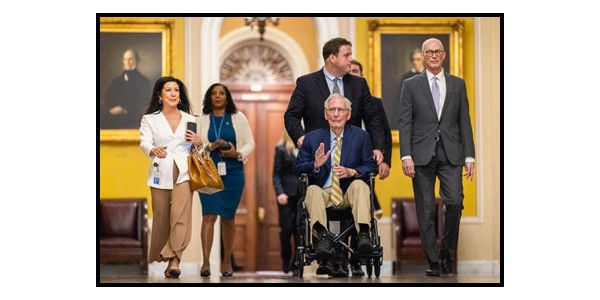


The first shows McConnell returning to the Capitol in a wheelchair in September. The hospital photograph shows his wife, Elaine Chao, beside him during his recovery; it was released publicly amid questions about his lengthy absence. The other images provide context from before and during his hospitalization.
Conversational Summary
The central story is that McConnell has returned to Senate work after a serious, months-long health interruption, but his public appearances have renewed questions about his health and ability to carry out Senate duties. Those questions are politically consequential because his vote helped Republicans move the farm bill out of committee.
However, the article’s final statement—saying he is “not serving” but “being managed”—is the author's judgment, not an established fact. The documented facts are that McConnell remains in recovery, uses a wheelchair, received assistance during the committee proceedings, cast his own recorded “aye” vote, and says he intends to continue serving through the end of his term.
[ChatGPT]
If you wish to see the DETAIL
Document FOLLOWS”
Mitch McConnell, 84, visibly struggles to speak during Senate committee vote after 90-day absence
By Craig Barlow |
September 17, 2026
See more of the truth in your search results. Click below, then SELECT the checkbox.
Senator Mitch McConnell returned to Capitol Hill this week after more than three months away, and video from a Wednesday committee meeting showed the 84-year-old Republican appearing unable to speak without help from colleagues beside him.
McConnell attended the Senate Agriculture Committee's markup of the Farm Bill, formally titled the Agricultural Act of 2026, on Wednesday. Video from the meeting showed two colleagues appearing to tell McConnell it was time to cast a vote and instructing him to vote "Aye" on the legislation. Committee Chairman John Boozman greeted McConnell as he arrived. McConnell's chief of staff, Terry Carmack, was also seen speaking with the senator during the proceedings.
It was the first time McConnell had been widely heard since his return to Washington on Monday, and the footage raised fresh questions about the Kentucky Republican's fitness to serve out the remainder of his term.
A fall in June, then silence for months
McConnell fell at his home on June 14. He was briefly hospitalized and later diagnosed with a mild case of pneumonia, his office disclosed. Weeks after the hospitalization, he spoke with congressional colleagues by phone and indicated he was recovering.
His office released a photograph on July 12 showing McConnell and his wife holding a newspaper dated that day. Some observers initially suspected the image was AI-generated. A second photograph followed on July 27. A medical statement from McConnell's doctor, attached to one of the photos, said the senator "continues his recovery from a fall at home in June" and had "maintained a strenuous course of physical therapy and rehabilitation" since his discharge.
Members of both parties pressed for more information. Neither the doctor's name nor the specific hospital where McConnell was treated has been publicly disclosed.
McConnell acknowledged he is "not quite back to 100%"
On Monday, before the committee video surfaced, McConnell posted on X about his condition. He wrote that recovery:
"has been a long and often frustrating process, and the lingering effects of childhood polio haven't made it any easier."
He added:
"I'm still not quite back to 100%, but I've assured Leader Thune that, as I continue with physical therapy on the advice of my doctors, I will do my best to be present for tough votes when our Conference needs me."
McConnell also spoke briefly with reporters outside the Senate chamber on Monday, though congressional rules prohibit recording in that hallway. He indicated he was looking forward to returning to the Senate floor and thanked Kentuckians for their well wishes.
Wednesday's footage was not the first alarming episode
Before his June fall, McConnell froze during a hearing in May while chairing a session of the Senate Appropriations Committee's Defense Subcommittee. During that episode, staffer Robert Karem interrupted McConnell to inform him that Democratic Senators Tammy Baldwin of Wisconsin and Jeanne Shaheen of New Hampshire, along with Republican Senator John Kennedy of Louisiana, still had questions. The hearing continued for another 30 minutes after Karem's interjection.
A clip of the interaction circulated online. President Trump subsequently posted on Truth Social, calling Karem a "bum."
McConnell led Senate Republicans for nearly two decades, the longest tenure for any party leader in the chamber's history. He is not seeking re-election in this year's midterm elections.
Unanswered questions keep piling up
McConnell's office has not identified his treating physician by name, disclosed the hospital where he was admitted, or provided a detailed accounting of his medical condition beyond the brief written statement and his own social media post. The identities of the two colleagues who guided him through Wednesday's vote have not been publicly confirmed.
The senator cast his "Aye" vote on the Farm Bill markup. But the gap between what voters saw on video and the reassurances from McConnell's office is wide, and growing wider with each public appearance.
Voters in Kentucky and across the country deserve a straight answer about whether their senator can do the job. A man who needs colleagues to tell him when and how to vote is not serving, he is being managed.
The Night Cap
Daniel Brooks INPUTS:
Dan’s Daily Briefing — September 18, 2026
1. Canada’s EU “associate membership” encounters practical limits


Facts: European diplomats and Canadian officials are tempering expectations surrounding the proposed EU “associate membership” for Canada. Reuters reported on September 18 that several EU governments were not consulted before Commission President Ursula von der Leyen publicly proposed the unprecedented status.
Any comprehensive arrangement would have to navigate provincial authority over natural resources and other policies. Canada also remains heavily integrated with American defence, intelligence and supply systems. Talks are expected to continue at an October summit in Montreal. Reuters, published September 18
Why it matters to Dan: This supplies the reality check missing from the week’s dramatic headlines. Closer European trade, defence procurement and critical-mineral cooperation could benefit Ontario, but no ready-made EU membership package is sitting on a Brussels shelf awaiting Canada’s signature. Diversification is prudent. Pretending geography, provincial jurisdiction and deeply integrated American supply chains can be negotiated away during one congenial European lunch would be something else entirely.
2. Russian oil exceeds US$120 as China searches for Gulf alternatives


Facts: Russia’s ESPO crude rose above US$120 per barrel on September 18, carrying record premiums of approximately US$20–30 over Brent as Chinese refiners sought alternatives to disrupted Middle Eastern supplies.
Large Chinese state-owned companies have reportedly secured most available November and December ESPO shipments. Russian Urals crude also reached approximately US$110. American legislation now permits President Trump to impose tariffs targeting countries buying Russian oil, although he has not announced how broadly he will use that authority. Reuters, published September 18
Why it matters to Dan: The Iran conflict is strengthening Russia’s energy revenues while the West is still trying to restrict Moscow’s war financing—a geopolitical circle that would make a pretzel feel structurally uncomplicated.
For Ontario, shifting Chinese demand into Russian and other alternative grades keeps pressure on the entire petroleum market, even as Brent temporarily falls. Diesel, fertilizer and freight remain more useful preparedness indicators than the headline crude benchmark alone.
Prediction: Aggressive American penalties on Chinese purchases could reduce Russian revenue eventually, but initially risk tightening global supply and raising prices further.
3. Judge blocks Montana’s one-sided election-deepfake law

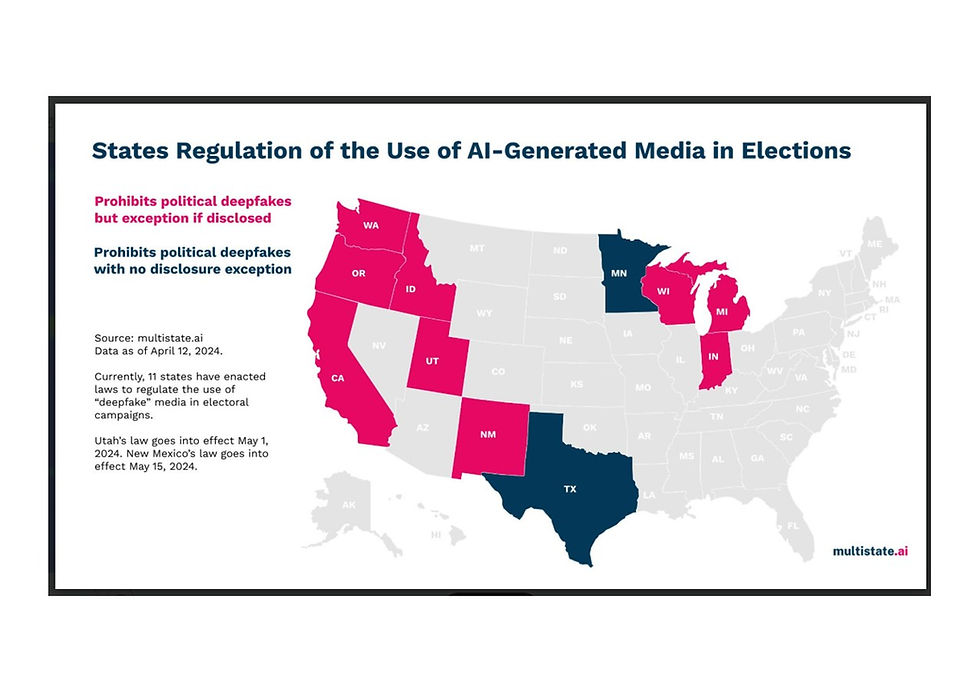

Facts: U.S. District Judge Susan Watters issued a preliminary injunction on September 17, preventing Montana from enforcing its election-deepfake law against a conservative political group.
The law prohibited undisclosed AI-generated material intended to harm a candidate but did not apply equally to material supporting one. The judge found that this viewpoint-based distinction likely violated the First Amendment. The ruling protects the plaintiffs while litigation continues; it does not invalidate every restriction on deceptive AI election content. Reuters, published September 17
Why it matters to Dan: Governments have a legitimate interest in preventing fraudulent impersonation, but “AI misinformation” cannot become a label applied only to unfavourable political speech. Disclosure rules applying evenly are easier to defend than laws protecting candidates from synthetic criticism while allowing synthetic praise.
For media work, the lesson is to preserve originals, editing histories and provenance. In an AI election, being able to prove an image is authentic may become as important as identifying one that is fake.
4. Historic Baptist church opens centre commemorating racist bombing


Facts: Birmingham’s 16th Street Baptist Church marked the September 15 anniversary of the 1963 Ku Klux Klan bombing by opening a new visitor and education centre.
The attack killed Addie Mae Collins, Denise McNair, Carole Robertson and Cynthia Wesley and injured more than 20 other people. The church had served as an organizing centre during the civil-rights movement. Three Klansmen were eventually convicted, beginning 14 years after the bombing. Associated Press, published September 16
Why it matters to Dan: This is Christian history as both witness and warning. A church stood at the centre of a movement insisting that human dignity comes from God, while terrorists used racial ideology and violence to attack children inside that sanctuary.
Remembering the bombing should not require accepting every present-day political claim made in its name. It does require rejecting racial hatred without qualification and recognizing that courageous churches can materially change public life.
5. Anthropic builds a physical biology laboratory for AI research


Facts: Anthropic has established a wet biology laboratory in the San Francisco Bay Area, Reuters reported on September 18. The facility allows researchers to connect Claude-based scientific systems with physical experiments, robotics and drug-discovery work.
The company says its initial focus includes difficult and neglected diseases rather than selling drugs directly. Anthropic has also acquired Coefficient Bio and added Novartis CEO Vas Narasimhan to its board. Reuters, published September 18
Unconfirmed: Anthropic has not publicly disclosed the laboratory’s complete experimental program, containment arrangements or the precise autonomy granted to AI systems.
Why it matters to Dan: This moves AI from producing text and images into proposing and helping execute experiments in the physical world. The potential for faster drug discovery is enormous, but errors now carry consequences beyond an embarrassing paragraph or incorrectly rendered vehicle badge.
The same governance principles scale upward: restricted permissions, human authorization, complete logs, isolated testing and emergency shutdown procedures. Once the chatbot has access to laboratory robots, “we’ll fix it in post” is no longer a terribly reassuring safety plan.
Daniel Brooks
Patrick Bestall’s INPUT:

#1. COUNTDOWN to Election Day, October 26: 6 WEEKS left

----- Forwarded Message -----
From: CCAL <ccal.info2030+gmail.com@icontactmail6.com>
Sent: Wednesday, September 16, 2026 at 02:32:15 PM EDT
Subject: COUNTDOWN to Election Day, October 26: 6 WEEKS left
Here's your weekly update leading up to election day.
THIS WEEK:
Ward Debates: details: https://londondecides.ca/meetings/
Sept 19 WARD 11 Woodland Heights school, 1pmSept 19 WARD 13 Central Library, 2pmSept 22 WARDS 7&8 West Haven Golf Club, 7pm (registration required)
Please ask questions! You can just email your councillor, or try to ask one at a debate. Not sure what to ask? CCAL has a list of questions you may consider, we have sent these to all candidates so they will have seen them and should be thinking about them (we asked for replies by Sept. 25) link to CCAL list of questions for candidates: https://ccalondon.substack.com/p/we-asked-every-london-council-candidate
Council Video of the week: We present here a topic of concern and suggest you watch to see what decision was made, how councillors treated the topic, how they voted, and to determine: What (if anything) did YOUR councillor say/vote? Silences should also be noted.
TOPIC: Illegal drugs in shelters
Meeting/date: Council meeting Aug. 25/2026
start/end time: from 1:55 to 4:58, when they go “in camera”. What do you think about the way councillors questions were framed, as opposed to the actual questions they asked? (Note that on youtube you can also increase the speed or jump to sections where your councillor speaks, as desired)
What do you think of THESE replies?
from School Trustee candidates

TVDSB school trustee candidate: Lincoln McCardle running for: Wards 7, 8, 9, 10 & 13
· Will you support an immediate, board-wide return to a focus on systematic, explicit phonics instruction, leaving other methods such as “whole language learning” as supplementary only?NO. I'm not here to tell teachers how to do their jobs and to be honest neither are you.
· Will you support a return to traditional, evidence-based math instruction, that emphasizes rote competence and foundational fluency?No. Let children learn and research has showed us work. I'm not advocating for any method in particular.
· Will you support policies reserving washrooms, changerooms, and overnight accommodation spaces, strictly to students of the same biological sex?
No. Honestly WTF?
link to more CPAL questions for trustee candidates: https://cpal.substack.com/p/cpals-list-of-election-questions

.PB
#2.
BC Debt outdoes any where else!
BC COST of LIVING INDEX

TOP STORY
New figures show that B.C. is running up debt faster than any other subnational jurisdiction in North America, including famously indebted U.S. states such as California and New York.
The province’s deficit forecast now stands at $13.8 billion for the year, according to an update released this week by the B.C. Ministry of Finance.
That’s equivalent to $2,400 in new debt for every single resident of the province. Or, about $46 in new debt per resident, per week.
The figure not only dwarfs the relative debt accumulation of any other Canadian province, but of all 50 U.S. states.
The B.C. deficit is so high, in fact, that it will almost exactly match this year’s deficit in Ontario, a province with more than three times the population.
The latest estimates from the government of Ontario Premier Doug Ford also put their deficit at $13.8 billion.
But with more than 16 million Ontarians (as opposed to 5.7 million British Columbians), Ontario's deficit will work out to a per-capita rate of about $850.
The Quebec government of Christine Fréchette has come in for criticism for its fiscal imprudence. One issue that emerged in the province’s ongoing provincial election was a Santé Québec IT project that ballooned from $98 million to more than $1 billion.
But Quebec’s budget deficit this year is still pegged at roughly half of B.C.’s, despite a larger population and larger GDP. The most recent estimates have Quebec’s deficit at $7.2 billion.
B.C.’s rate of debt accumulation also dwarfs anything seen among U.S. states, even those notorious for their spendthrift finances.
California is on course to run a deficit this fiscal year of $26 billion (US$18.5 billion). It’s roughly double B.C.’s deficit, but in a state with eight times the population and more than 10 times the GDP. Per capita, the California deficit works out to the equivalent of C$660.
The contrast is even more stark in New York State, whose total deficit is expected to come in at about the same amount as in B.C.
New York is planning for a three-year deficit equivalent to about $48 billion. Or, about $16 billion per year.
This means the New York budget deficit will only be about 15 per cent higher than British Columbia’s, despite a GDP of about C$3.4 trillion, as compared to B.C.’s GDP of about $430 billion.
The awesome scale of the B.C. deficit stands in sharp contrast to the fact that, only a few years ago, B.C. was running one of the most fiscally responsible budgets in Canada.
Under NDP premier John Horgan, B.C. ran surpluses in both 2018 and 2019 before finances were sent massively into the red by the COVID-19 pandemic.
However, less than two years after the beginning of COVID lockdowns, Horgan was able to restore the provincial budget to surplus. In 2022/2023, B.C. took in $704 million more than it spent.
What changed was Horgan’s replacement in November 2022. In his tenure so far, Premier David Eby has presided over the fastest rate of debt accumulation in the province’s history.
Total B.C. debt stood at $89.4 billion on Eby’s first day in office and is now projected to breach $180 billion by 2027.
B.C. is running up these record deficits despite the fact that provincial revenues are now being padded by a sharp increase in royalties from natural gas.
LNG Canada, the country’s first LNG export facility, opened last year on the B.C. coast.
In fact, B.C.’s budget deficit came in about $1.5 billion higher than expected because the province’s Ministry of Energy and Climate Solutions had initially miscalculated the expected amount of natural gas royalties.
The mistake was to apply a U.S. dollar conversion to amounts that were already expressed in Canadian dollars.
This is also a particularly bad time to be taking out record levels of provincial debt, with rising interest rates spiking the cost of debt servicing.
When Eby took office, B.C. paid about $2 billion per year in interest charges. It’s now triple that, with this year’s debt servicing costs expected to top $6.3 billion.
This week, two former B.C. finance ministers told Postmedia that B.C.’s current rate of debt accumulation was unsustainable.
“The engine of growth can’t be the public-sector jobs, because it seems to me that in the last few years, the public sector has grown disproportionately, and of course the deficit has just ballooned after Horgan,” Ujjal Dosanjh, NDP finance minister in the 1990s, told the Vancouver Sun.
.PB
#3.
Ottawa Spends $1.4 B to study what!???

Makes me want to apply for a grant to study Ottawa's $1.4 Billion research fund.
.pb
(Then I'll just ask AI to write the report for me.)
.PB
#4.
Free internet course on Farming, Homesteading & laying hens

.PB
#5.
Allison Inquirey Day 3


.PB
#6.
Food shortages?

Do you think we can get more food from around the world?
"Famine" doesn't come until the next cycle in our Chart. Right now many people have started prepping, gardening and farming better.
.PB
#7.
Saudis & Israelis team up

Who could have seen this coming? Don Brooks and I did. See the 40 minute video we made before AI came along.
.PB
#8.
Beware of "Professor" Jiang videos

Self-styled “professor” Xueqin Jiang became an internet sensation after a 2024 video he posted to his YouTube channel went viral. In the video, Jiang made three big predictions: Trump would win the 2024 election, the US would go to war with Iran, and ultimately, the US would lose that war. He has been dubbed “China’s Nostradamus,” and his YouTube channel now has more than 2 million subscribers. But in this ‘Mehdi Unfiltered’ interview, Mehdi Hasan challenges Jiang on how accurate – or unique! – those predictions are, including the big 2024 prediction he got wrong; whether he has slipped into antisemitic conspiracy theorizing; and why exactly his YouTube channel isn’t being censored by China. In this provocative and wide-ranging interview, Mehdi also presses Jiang on peddling conspiracy theories about the Illuminati and the Jesuits, as well as his promotion of the far-right concept of “Pax Judaica.”
I already had serious questions after the sudden appearance of Jiang on dozens of videos appearing almost overnight. Especially after I heard him say that Stalin was a "Messiah" figure to the Russians! Huh? Are we talking the same Stalin who closed all the churches and killed millions of Christians?
You know how the Chinese Communist Party could easily create a "Nostradamus" like Jiang? Easy. Pick a dozen or so candidates and instruct each of them to make predictions. The odds are that one of them is going to be mostly right. Then you've got your man to carry water for you. (I should say "fire".)
PS - Compare Jiang's few predictions to the many made by Don Brooks and I in our 6 Cycles of God chart. We've been right on every one since we wrote our booklet in 2012-2014 "Church - Coming of Age". Nobody believed us back then that Europe would be overwhelmed by waves of illegal Muslim migrants, or that the USA and France would once again see the same kind of internal conflicts that started those nations.
.PB
The Six Cycles of God


Be sure to READ [PART-TWO]
![FRIDAY [Part-TWO]](https://static.wixstatic.com/media/7f1dc1_5992449c85494187866071c50e42eeb9~mv2.jpg/v1/fill/w_980,h_980,al_c,q_85,usm_0.66_1.00_0.01,enc_avif,quality_auto/7f1dc1_5992449c85494187866071c50e42eeb9~mv2.jpg)

![WEDNESDAY [Part ONE]](https://static.wixstatic.com/media/7f1dc1_171297f3cb5e47d4b3cb480dab9b2b65~mv2.jpg/v1/fill/w_980,h_980,al_c,q_85,usm_0.66_1.00_0.01,enc_avif,quality_auto/7f1dc1_171297f3cb5e47d4b3cb480dab9b2b65~mv2.jpg)
Comments