SUNDAY / MONDAY

New BLOG – Great ARTICLES
SUNDAY/MONDAY 10 -[04/05]-26
SPIRITUAL:
Verse-for-TODAY:
New International Version
Seek the Lord while he may be found; call on him while he is near.
Read all of Isaiah 55 ►
Feast of SUKKOT:
This feast ends on the 8th Day [Sunday] the 1-year Anniversary of the 1200 SLAUGHTERED in ISRAEL ONE-YEAR-AGO!
To Honour & Support ISRAEL we planted 1200 FLAGS in a figure 8 [INFINITY] symbolizing ETERNITY!
Here are some pictures...


CANADIAN:

SHORT SUMMARY [ChatGPT]
Prime Minister Mark Carney says Canada’s immigration system is “under control” and that Ottawa can eventually resume a controlled increase in population. Critics argue immigration levels remain historically high and that rapid population growth has already contributed to housing pressures, strained healthcare and schools, youth unemployment, and wage competition, particularly in Alberta.
The article also criticizes Carney’s push for closer ties with the European Union, warning Canada could repeat Europe’s immigration and integration problems. Its central argument is that Ottawa controls immigration levels while provinces such as Alberta bear much of the cost, fueling demands for greater provincial control.
Western Standard
Daily Newsletter
TRUMP:
Hypocrite Elissa Slotkin LOSES IT when Markwayne Mullin SHUTS DOWN her BS

“I don’t think it’s too much to ask somebody to prove they are a citizen before they vote!”
DHS Sec. Markwayne Mullin fired back at Democrat Sen. Elissa Slotkin for spouting ungrounded accusations against ICE and President Donald Trump, including the theory that Trump plans to “steal” the midterm elections by deploying agents at voting sites.
“I don’t think it’s too much to ask somebody to prove they are a citizen before they vote!” Mullin told Slotkin. “If there is a threat to that polling area, we will work with local law enforcement! There would be a reason for us to be there and it will be known why we are there!”
Megyn Kelly blasts Gov. Hochul, Letitia James over “Cornell 7” case

Megyn Kelly criticized Gov. Kathy Hochul for appointing AG Letitia James to oversee the “Cornell 7” gang-rape investigation, calling James biased and arguing her prior public sympathy for the accuser showed she’d already taken a side before the probe began.
· Kelly pointed to a Facebook post from James expressing support for the alleged victim as evidence of prejudgment, and noted James declined to address the post when questioned by a reporter at a joint press conference with Hochul.
· Kelly expressed strong concern for the accused fraternity members, characterizing the allegations as stemming from “a night of debauchery” - “I am very worried for them. I am seriously concerned for these seven young men, who appear to have engaged in a night of debauchery, [and some] sent out — in the case of one or two of them — f—ing stupid, offensive texts messages,” she explained.
· The case centers on an alleged gang rape at Cornell's Chi Phi fraternity house in October 2024. A woman identified only as "Jane Doe" says seven fraternity brothers assaulted her that night. She reportedly went to police after discovering messages in which the men allegedly bragged about the incident. Last month, she filed a civil lawsuit against the seven men, which brought the case into the national spotlight.
US WEEK IN REVIEW — Trump Administration

SUMMARY [ChatGPT]
President Donald Trump announced a series of economic and policy initiatives highlighted by a one-time $90 Medicare payment for more than 20 million seniors, intended to help cover Part B premiums. The administration says this marks the first direct use of the Medicare Improvement Fund for payments of this kind. Pasted text
Another major announcement was a planned $15 billion Mesabi Metallics steel complex in Lee County, Iowa.
According to the document, the project is expected to create 1,750 permanent jobs, up to 6,000 construction jobs, and an estimated $95 billion in economic output. Trump also moved to reverse previous mining policies in an effort to expand a domestic “mine-to-mill” steel supply chain. Pasted text
The administration also highlighted changes to fuel-economy regulations, increased forecasts for U.S. oil production, a new U.S.-China Board of Trade, and $16.8 billion in newly announced investments during the week. Pasted text Pasted text
On Capitol Hill, the document says Senate Democrats opposed the Stop Insider Trading Act, which included restrictions on stock purchases by members of Congress and their immediate families; notably, the bill also contained a voter photo-ID provision. Separately, the President’s Council of Economic Advisers estimated that selected Democratic Socialists of America policies would cost $49 trillion over ten years—an administration estimate rather than an independent fiscal finding. Pasted text
Bottom line: The White House presented the week as centered on senior cost relief, American manufacturing and mining, energy production, investment, and government reform, while also drawing sharp contrasts with Democratic economic policies.
US Week
GLOBAL:
Georgia Block Party Shooting kills two and wounds 35

By
Gunfire at a Vienna, Georgia block party left two men dead and 35 injured early Sunday, with no suspect or motive yet named by investigators.
Sheriff’s deputies in Dooly County heard shots ring out around 1:25 a.m. while patrolling and raced to a neighborhood gathering on Pine Street. They found multiple people already hit by gunfire.
Two of the wounded men, ages 20 and 23, were located several blocks from the Pine Street origin point and pronounced dead at the scene. Another 35 people were hurt and taken to several hospitals in the area.
CBS News reported that Dooly County Coroner Brett Walls confirmed both of the dead were men in their early 20s. Neither the dead nor the injured have been publicly identified.
Vienna sits in southern Georgia, about 50 miles south of Macon. What began as a local block party ended in a mass-casualty crime scene before dawn.
GBI takes the lead as answers stay scarce
The Dooly County Sheriff’s Office requested help from the Georgia Bureau of Investigation. GBI agents joined the probe and later described the investigation as “active and ongoing.”
The Georgia Bureau of Investigation said its Medical Examiner’s Office will perform autopsies on both men killed. Authorities have released no information on a possible suspect, a motive, or the weapon used.
No arrests have been announced. No timeline beyond that early-morning window has been filled in. Investigators have not said how the two fatally wounded men ended up blocks away from where the shooting started.
Thirty-seven people struck by gunfire at a neighborhood party is not a mystery that fixes itself. Families in Dooly County are waiting on names, on evidence, and on someone held to account.
When a quiet southern town wakes up to two dead and three dozen wounded, the bare minimum is a full investigation that does not stall, and a justice system that treats street gunfire as the serious crime it is.
The AMERICAN Almanac
Daniel Brooks INPUTS:

Dan’s Daily Briefing — October 5, 2026
BrightNews.ai was checked during discovery. None of its available leads displaced the five independently supported developments below.
1. Ontario’s C$5-billion tariff fund has distributed only C$140 million
Facts: Ontario officials disclosed that the province’s C$5-billion Protect Ontario account has so far provided C$140 million to businesses affected by American tariffs.
That includes C$100 million for Algoma Steel and approximately C$40 million divided among 18 other approved applications. Only 36 applications, requesting less than C$100 million altogether, had been received. A planned private-sector investment arm remains on paper but is not actively advancing. Global News published the figures September 30. Globalnews.ca
Why it matters to Dan: Holding money in reserve during an unpredictable trade war is defensible. Announcing billions while creating a program that few businesses can access is not the same thing as protecting Ontario employment.
London-area manufacturers need understandable eligibility rules, rapid decisions and support tied to viable production—not political cheques for whichever distressed corporation has the largest lobby. A five-billion-dollar fire extinguisher is less impressive when nobody can find the release pin.

2. Flávio Bolsonaro defeats expectations and forces a runoff with Lula
Facts: Right-wing Senator Flávio Bolsonaro received approximately 47% of Brazil’s October 4 first-round presidential vote, compared with roughly 45% for incumbent Luiz Inácio Lula da Silva. They will contest a runoff on October 25.
Bolsonaro’s performance exceeded pre-election surveys that had placed Lula ahead. The campaign centred on living costs, crime, corruption and economic stagnation; Brazil’s public debt exceeds 82% of GDP. Reuters
Why it matters to Dan: This is the final result of the campaign previously disrupted by a false claim about Brazil’s patron saint. The allegation did not prevent Bolsonaro from finishing first, although neither candidate reached a majority.
Brazil is a major agricultural, mining and energy power. Its relationship with China, Trump and the wider Americas will affect commodity markets and geopolitical alignments. Christians should judge the runoff on policy and character rather than manufactured religious rumours—bearing false witness remains wrong even when the target wears the opposing jersey.

3. Emergency oil releases lower crude prices—but diesel remains tight
Facts: G7 governments have agreed to release 100 million barrels of diesel and crude stocks. Recovering Middle Eastern exports also pushed Brent crude toward US$101 per barrel on October 5.
The relief is uneven: Asian gasoil futures rose more than 4% after China suspended petroleum-product exports for October. Saudi Aramco’s chief executive warned that rebuilding depleted global emergency inventories could take two years. reuters.com
Why it matters to Dan: The releases reduce immediate fuel pressure and make an American diesel-export ban less likely. They do not repair damaged refineries or restore Chinese exports.
For Ontario preparedness, watch retail diesel, heating oil and freight costs rather than celebrating every decline in crude. Rotate safely stored fuel, keep vehicles reasonably filled and avoid panic buying. Strategic reserves can smooth a crisis, but drawing them down converts today’s shortage into tomorrow’s thinner safety margin.
Prediction: Crude may soften further while diesel and freight prices remain elevated because refined-product supply is still the bottleneck.

4. French debt fears push the euro to a 17-month low
Facts: The euro fell as low as US$1.1160 on October 5, its weakest level in 17 months, amid concerns about French debt and political gridlock.
The yield premium demanded for French ten-year debt over German bonds exceeded 150 basis points. French ten-year yields approached 4.92%, while investors questioned whether Parliament would approve or preserve the government’s deficit-reduction plan. Reuters
Why it matters to Dan: France is not a peripheral economy; sustained doubt about its debt could destabilize European banks, weaken the euro and encourage capital to move into American dollars and government bonds. That can indirectly pressure the Canadian dollar and raise the cost of imported goods.
Gold gained modestly, but precious metals remain volatile when yields are high. This environment favours liquidity, limited leverage and diversified maturities over betting the emergency fund on one supposedly inevitable currency collapse.
Prediction: If France cannot enact credible fiscal reforms, concerns will spread beyond French bonds into the wider eurozone.

5. Deutsche Telekom places a price tag on AI automation
Facts: Deutsche Telekom said on October 5 that AI and automation could reduce indirect costs by approximately €2.5 billion by 2030, relative to 2023.
The company expects €1.1 billion in gross savings outside the United States during 2027. It uses AI to anticipate network congestion and assist customer-service employees, while targeting €800 million in AI-related business revenue by 2030. Some savings will be reinvested in fibre and German digital infrastructure. Reuters
Unconfirmed: These are management forecasts, not completed savings, and the company has not publicly separated gains from staff reductions, avoided hiring or other cost changes.
Why it matters to Dan: This is a more useful AI benchmark than model demonstrations or speculative valuations: identify a workflow, calculate the savings and measure the result.
For your media operation, automation proposals should specify saved production hours, reduced corrections, faster asset delivery and the human review that remains necessary. “AI strategy” becomes considerably less mystical once somebody must attach a number, an owner and a deadline to it.

Patrick Bestall’s INPUT:

#1.
Trump Sends Nearly $100 to Seniors, Socialism's $49T Price Tag, and the Insider Trading Vote

SUPER COOL NEWS FROM THE TRUMP ADMINISTRATION. IN THIS CASE THE TRUTH BLESSES!
SHORT BLOG SUMMARY [ChatGPT]
— MONEY BACK & MADE IN AMERICA
The Trump administration announced a busy week of economic and domestic-policy initiatives, headlined by a one-time $90 payment to more than 20 million eligible Medicare Part B enrollees. The money will come from the Medicare Improvement Fund, and most eligible recipients are expected to receive it by direct deposit in early October. The White House says this is the first time the fund has been used for direct payments to beneficiaries. Independent reporting confirms the payment announcement. The White House
Another major announcement is a proposed $15 billion Mesabi Metallics steel complex in Lee County, Iowa, which the White House describes as the largest steel plant ever built in the United States. The project is projected to create 1,750 permanent jobs and as many as 6,000 construction jobs, while connecting Minnesota iron ore with Iowa steel production. The White House
The administration also highlighted changes to mining and energy policy, a new America.gov initiative intended to simplify access to federal services, and other manufacturing and trade initiatives.
Important context: the newsletter's $49 trillion “cost of socialism” figure comes from a President's Council of Economic Advisers analysis of selected Democratic Socialists of America policies; it is an administration estimate, not an independently established cost. Likewise, claims about the economic effects of regulatory changes should be presented as administration projections rather than settled outcomes.
BLOG TAKEAWAY: The clearest concrete headline is straightforward: $90 for more than 20 million Medicare beneficiaries, alongside a huge new American steel investment — two announcements emphasizing direct financial relief and expanded domestic manufacturing.
.PB
#2.
"France is the trigger"


.PB
#3.
Indigenous spending flop despite 4X more $

.PB
#4.
Canada’s Broken System: Criminals Get Coddled, Canadians Get Screwed

A woman was randomly assaulted, raped, and left with permanent brain damage. The sentence: 12 years. Is this justice? Sonduren Fanarredha 2 hours ago On this epsiode of Sonduren Uncensored, Sonduren looks at a shocking assault case that raises fresh questions about Canada’s justice system and whether victims are getting anything close to the justice they deserve.
A woman was left with permanent, life-altering brain damage, while her attacker received a miserably low 12-year sentence. Sonduren asks, ‘Is this justice?’ Then, it’s the latest food-safety controversy involving Driscoll’s berries.
A whistleblower alleges millions of pounds of fruit with non-compliant pesticide levels entered Canada, while the CFIA says its inspections did not result in recalls or corrective action. Tim Hortons is also in the crosshairs, with bankruptcy filings revealing just how heavily some franchisees have relied on temporary foreign workers rather than hiring Canada’s youth.
That leads into a much bigger question about Canada’s immigration system — and who is actually benefiting from it. Get exclusive access to Sonduren Uncensored with a premium Juno News subscription.
Mark Carney’s comments about getting Canada’s immigration system “back under control” raise another round of questions about population growth. Meanwhile, B.C.’s drug crisis has reached another low, with volunteers reportedly giving naloxone to crows found unconscious after suspected fentanyl exposure.
The discussion turns to David Eby, B.C.’s approach to the crisis, and the growing frustration over public drug use. The liberal way; taxpayer Canadians treated like cannon fodder for the elite WEF clown show. Carney should be in prison for life on immigration alone This is not justice whatsoever. There does not seem to be justice, in Canada, or anywhere else.
Allowing assailants to be protected by not havig their faces shown is a fine example of how upside down this system is. The victims get further victimized, while the criminals are protected. Like not being able to call a pedophile a pedophile, no, they are young-attracted persons, or whatever the stupid name is. Shop at your farmers market, not the corporate grocery stores.
Any Parliamentarian or Government worker that have any affiliations with the WEF should be jailed for treason. Especially our Prime Minister as well as our last Prime Minister. They are pushing the One Global Government Agenda NOT what Canadians put them into power for. I did not vote for anything that has happened in the last 12 years. They simply do it with no oversite, no transparency and no mandate from us. Enough is enough.

.PB
#5.
The Farmer and the Algorithm

How artificial intelligence is quietly transforming the way we grow food — and why the most exciting opportunity has nothing to do with robots harvesting lettuce.
Picture a farm in central Illinois. About 3,000 acres of corn and soybean country, worked by the same family for generations. A few years ago, the farmer there decided to try something different. He cut back on tillage, planted cover crops between his cash crop cycles, and started paying attention to his soil in a way he hadn’t before. Not just whether it was wet or dry, but what was living in it.
The results surprised him. Moisture retention went up. The soil held more organic matter. Nutrients cycled better. His fields, over time, started to feel different underfoot — spongier, more alive. He described the transition as demanding, though. New knowledge, new equipment, and a period of uncertainty while biology got its footing.
What he was practicing has a name: regenerative agriculture. And it is increasingly being paired with a technology that might seem, at first glance, completely alien to muddy boots and field notebooks: artificial intelligence.
This is a story about that pairing; what it actually looks like, why it matters, and what it might mean for the future of food.
First, a word about scale
AI in agriculture is not a fringe experiment. It is a rapidly growing industry, projected to expand from $1.7 billion in 2023 to $4.7 billion by 2028.1 Estimates suggest that combining AI with digital farming tools could add more than $450 billion a year to agricultural output in developing countries alone, a 28 percent improvement over what those countries might otherwise achieve.1
The pressure driving this investment is real. Agriculture already accounts for 72 percent of all the freshwater humans withdraw from rivers, lakes, and aquifers.2 About a third of the world’s farmland is degraded, so that it has become less productive.2 And by 2050, we will need to feed roughly ten billion people. That is a lot of pressure on a system that is already showing cracks.
AI is already involved in farming activities that increase production and reduce resource use. A major 2025 review of four years of field research found that AI-powered tools had moved well beyond lab demonstrations and into real farms, achieving accuracy rates above 90 percent in detecting crop diseases and pests, and delivering measurable improvements in how efficiently farms use water, fertilizer, and other resources.3
What AI is actually doing on farms right now
If you want to see where AI is already earning its keep, start with precision farming. The idea is simple: instead of treating an entire field as a uniform surface and applying the same water, fertilizer, and pest control everywhere, you treat each square meter individually based on real data. AI makes that possible by processing the flood of information coming from satellites, drones, soil sensors, and weather stations faster and more accurately than any human could.
Computer vision systems can now identify the first signs of fungal disease in a crop before a farmer walking the field would notice anything wrong. Robotic weeders — like those built by Harvested Robotics — can roll through a field and mechanically pull weeds without herbicide, distinguishing weeds from seedlings by size and species.5 Predictive platforms crunch historical weather patterns, soil data, and market prices to help farmers decide when to plant, when to irrigate, and when to harvest.
According to one thorough review of the field, AI is transforming farming across the entire supply chain, not just what happens in the field, but how food is processed, stored, and distributed.4 A compound annual growth rate of 25.5 percent over the next few years reflects how seriously the industry is taking this.4
But here is the problem. Most of these tools were built to optimize conventional, industrial farming; to grow more corn per acre of flat, chemically managed land. Applied to that kind of farming, AI can actually make some existing problems worse: pushing monocultures harder, reducing ecological diversity, and treating the farm as a factory floor rather than a living system.6 The more interesting question is what happens when you point these tools in a different direction.
What regenerative farming actually is
Before we get to the AI-regenerative agriculture connection, it helps to be clear about what regenerative farming actually means, since the term gets used loosely.
At its core, regenerative agriculture is the practice of farming in a way that actively improves the land rather than just extracting from it. That means using less tillage (or none at all, since plowing destroys soil structure and kills microbes). It means planting cover crops — things like clover, rye, or radishes — between cash crop cycles to keep living roots in the ground. It means bringing animals back into the rotation in managed ways, so their grazing and manure work with the land’s biology rather than against it. It means reducing synthetic fertilizers and pesticides and, as much as possible, replacing them with biological processes.
The goal is a farm where the soil gets better every year: more organic matter, better water retention, richer microbial life, more resilience against drought and heavy rain. It is a fundamentally different objective from conventional farming, which often maintains soil as a medium for holding crops upright while chemicals do most of the work.
What makes regenerative farming hard is that it is complex. Every decision about which cover crop to plant, when to graze, how to rotate, how much to till, interacts with dozens of local variables: soil type, rainfall, temperature, crop variety, and field history. There is no universal playbook. What works brilliantly in Iowa may fail in Georgia. This is precisely where AI becomes useful, because AI is very good at holding complexity.
The numbers behind the shift
A 2024 McKinsey survey of farmers worldwide found that 68 percent had already adopted crop rotations, 56 percent had moved to reduced- or no-till farming, and 40 percent were using variable-rate application technology. This means they were already adjusting their inputs field by field rather than blanket-spraying.7 These are not niche practices anymore. They are becoming mainstream.
Researchers and practitioners working at the intersection of AI and regenerative farming have identified five areas where the combination pays off most clearly: planning regenerative landscapes at scale using satellite data, tailoring practices to local conditions, reducing the financial risk of transitioning away from conventional methods, creating accountability in supply chains so buyers can verify what farmers are actually doing, and providing continuous field-level monitoring.8 All of these depend on the same underlying capability: making sense of large amounts of heterogeneous data quickly and translating it into decisions a farmer can act on tomorrow morning.
The soil is the whole game
If there is one thing that unites every aspect of regenerative agriculture, it is the soil. Everything from water retention, nutrient cycling, resilience to weather stress, and long-term productivity flows from having healthy, biologically rich, structurally intact soil. And for most of agricultural history, measuring soil health was slow, expensive, and inconsistent.
The conventional approach involved physically extracting soil samples, sending them to a laboratory, waiting weeks for results, and receiving measurements for a handful of locations across a field that might vary enormously. It was a bit like trying to understand a patient’s health by testing blood from five spots on their body, once a year, with a month’s delay between sample and result.
AI and satellite remote sensing are changing that completely. A 2025 study used data from two European Space Agency satellites, combined with a machine learning model called XGBoost, to map soil organic matter across farm sites in Japan and Togo. The model achieved a high degree of accuracy, which is exceptional for this kind of work, at a fraction of the cost of traditional sampling.9 What took months and lab fees can now be done continuously, from orbit.
A group of companies is developing commercial tools based on this science. Biome Makers sequences the DNA of soil microbial communities to provide farmers with a live portrait of their soil biology, showing which organisms are present, which are thriving, which are missing, and what that indicates for nutrient availability and plant health. Another company uses satellite imagery and machine learning to continuously monitor soil health indicators across entire farm portfolios, translating those measurements into outcome-based payments for farmers who show genuine improvement. Another soil modeling platform can reduce the cost of soil assessment by up to 90 percent compared to traditional sampling. And there is another methodology now officially approved by Verra (the global certification body) for evaluating soil health through digital mapping.10
Proving it actually works
One of the persistent frustrations in regenerative agriculture has been the difficulty of rigorously and cheaply proving that practices produce the outcomes farmers and buyers claim. A food company that wants to source from regenerative farms needs more than the farmer’s word for it. An investor financing the transition needs evidence. Historically, that evidence has been expensive to gather and inconsistent in quality.11 Furthermore, organic food labelling has proven to be an unreliable method for ensuring quality.
This is where AI-powered remote sensing becomes genuinely transformative. The same satellite platforms that can assess soil health can also monitor whether cover crops were actually planted, whether fields are showing signs of improved water retention, and whether biodiversity indicators are moving in the right direction. Continuous monitoring at low cost means that outcome-linked payments: paying farmers for verified ecological results rather than just for adopting certain practices, become financially feasible at scale.12 Because this is an issue of scale. If we want to replace glyphosate and petrochemical fertilizers in order to feed billions of people, regenerative farming has to be done at scale.
The legal and regulatory scaffolding is starting to catch up. In the United States, the Growing Climate Solutions Act created a USDA-administered pathway for farmers to participate in outcome-based agricultural markets. The European Union’s Carbon Removals and Carbon Farming Regulation, passed in 2024, established a certification framework with clear standards for verifying ecological outcomes from farmland. These are the institutional structures that AI-powered verification is being built to serve.13
The hardest part isn’t the technology
Ask anyone who has tried to transition a farm from conventional to regenerative practices, and they will tell you the hardest part is not buying new equipment or accessing new markets. It is the knowledge gap. Conventional farming is a well-documented, heavily supported system. There are extension agents, company representatives, and decades of research telling you exactly what to do in most situations. Regenerative farming is more experimental, more local, more dependent on the farmer’s own observation and judgment.
That Illinois farmer with 3,000 acres, no-till, cover crops, and careful attention to soil biology described the transition as demanding precisely because so much of the knowledge had to be built from scratch, one season at a time. Things improved. Soil water capacity went up. Organic matter levels rose. Nitrogen and phosphorus availability improved.14 But it took time, and there was real uncertainty along the way.
AI-powered advisory tools are beginning to close this gap. In May 2025, Farmland LP, a company that manages regenerative farmland as an investment asset, partnered with Microsoft’s Digital Impact Studio to explore how AI could support its operations. They identified around 35 potential applications and focused on 15 with the clearest near-term value. The starting point was unglamorous but essential: pulling together data that was scattered across accounting systems: field records, maps, and handwritten notes into a single place where AI could actually work with it. From there, conversational AI assistants, predictive crop models, and real-time alerts made it possible for farm managers to make better decisions faster, without drowning in information.15
The corporation, Boomitra, has technology that enables the measurement, reporting, and verification of soil carbon content, plant health, and soil moisture levels.
Boomitra is taking a version of this approach to smallholder farmers in South Asia and sub-Saharan Africa. Their AI assistant communicates in local languages and helps farmers implement regenerative practices step by step, while the platform’s satellite monitoring tracks whether those practices are actually improving the land. Verified outcomes trigger payments. The whole system: advice, monitoring, compensation, is designed to be accessible to someone with a basic smartphone and no technical background.16
Thinking bigger than a single field
One limitation of traditional farm management is that it stops at the fence line. But ecosystems do not. Water quality in a river depends on what is happening across its entire watershed. Pollinator populations depend on connected corridors of habitat. The resilience of a farming landscape, its ability to handle drought, flood, and pest pressure, depends on biodiversity and soil health distributed across many farms and landowners.
AI is starting to enable management at this larger scale. Satellite-based AI models can analyze land cover, soil conditions, and water availability across entire regions, identifying where regenerative practices would have the greatest impact and helping coordinate action across multiple landowners. Pilot programs in India’s Madhya Pradesh state have used this approach, integrating geospatial data from weather and satellite services to guide landscape-level planning and link that planning to financing for participating farmers.17
In Colombia’s Boyaca region, a similar initiative built around regenerative practices and digital tools produced a 36 percent increase in barley productivity, through better knowledge and coordination.17
A related trend is what the agricultural industry is calling “nature positive” farming. This is an approach that goes beyond soil health to actively measure gains in biodiversity. Acoustic monitoring technology can track which bird and insect species are present on a farm over time. Image recognition tools can survey plant diversity. These measurements are becoming part of the ecological scorecard that buyers, investors, and regulators are starting to ask for.18
The virtual farm
One of the more futuristic applications on the horizon is what researchers call an agricultural digital twin: a real-time virtual model of a farm that mirrors what is actually happening in the field. The idea is that a farmer could test a new cover crop rotation, a different grazing schedule, or a soil amendment strategy virtually before committing to it in the real world, learning from simulated outcomes rather than expensive trial and error. Given how nonlinear and complex regenerative systems are. how many variables interact in ways that are hard to predict. This kind of simulation could be enormously valuable.19 The technology is still early, but it is one of the most-watched trends in agricultural technology for the next several years.
What could go wrong
It would be dishonest to write about this technology without acknowledging its real risks. Three stand out.
The first is data ownership. Regenerative farming is deeply local; what works on one farm depends on the specific biology, hydrology, and history of that piece of land. Useful AI models need dense, high-quality local data, and that data is generated by farmers. If the commercial value from aggregating all that farm data flows primarily to technology companies and investors rather than to the farmers who created it, the technology will reproduce and deepen existing inequalities rather than addressing them.19
The second is bias. AI models are only as good as the data they were trained on. If the training data comes predominantly from large, well-capitalized farms in North America and Western Europe, the models will not perform well for smallholder farmers in Asia, Africa, and Latin America, who grow a large proportion of the world’s food. There is a real risk that AI-powered regenerative agriculture becomes an expensive tool for wealthy farms in wealthy countries, while the farmers who most need support are left behind.20
The third is cost. Drones, sensors, satellite subscriptions, AI advisory platforms, these things add up. A farmer who is already absorbing the income uncertainty of transitioning away from well-understood conventional practices is not well-positioned to also absorb significant technology costs. Making these tools widely accessible requires thoughtful subsidy programs, cooperative models, and public investment in the underlying data infrastructure.
Craig Wichner, who founded Farmland LP, put it well when he wrote that farming is deeply human work — that it requires judgment, intuition, and a relationship with the land that no algorithm can replicate. The most useful framing of AI’s role, he suggested, is not as a replacement for farmers but as a way of handling the tedious parts — data entry, monitoring alerts, routine analysis, so that farmers can spend more time on the work that actually requires their presence and expertise.21
What this is really about
Here is the thing about AI in agriculture that tends to get lost amid coverage of robots, satellites, and machine learning models: the technology itself is not the point. Technology is a tool. What matters is what you use it for.
For most of AI’s history in farming, it has been pointed at a narrow set of targets: yield per acre, cost per bushel, output per input. Those are important goals, but they are not the only ones that matter. A farm that maximizes short-term yield while depleting its soil, draining its aquifer, and eliminating the biodiversity that keeps it resilient is not a successful farm; it is a slow-motion failure.
What regenerative agriculture asks is that we optimize for different things: soil health, water retention, ecological function, and long-term productivity. These outcomes are harder to measure and slower to show up in quarterly reports. But they are the outcomes on which sustainable food production actually depends.
AI, properly directed, can make measuring and optimizing for those outcomes as tractable as measuring and optimizing for yield. The satellite platforms, the soil microbiome analyzers, the AI advisors, the outcome verification systems described in this piece are not theoretical. Many of them are running on farms today. The question is not whether the technology works. The question is whether we will build the supporting structures: equitable data governance, accessible financing, reliable verification standards, smart policy, that allow it to reach its potential.
That Illinois farmer is watching his soil get better, season by season, with better tools than he had when he started. That is what this technology, at its best, is for.
Thanks for reading Malone News! This post is public so feel free to share it.
Notes
1. AI market projection from MarketsandMarkets, “AI in Agriculture Market Size, Share & Trends Analysis Report,” 2024; digital agriculture GDP estimate from “Farms of the Future: How Can AI Accelerate Regenerative Agriculture?”, accessed February 2026.
2. Food and Agriculture Organization of the United Nations, “The State of the World’s Land and Water Resources,” FAO, 2022, https://www.fao.org/land-water/en/.
3. Adinarayana et al., “Artificial Intelligence in Sustainable Agriculture: Towards a Socio-Technical Roadmap,” ScienceDirect, October 27, 2025, https://www.sciencedirect.com/science/article/pii/S2772375525008093.
4. Ajaharuddin et al., “Artificial Intelligence in Agriculture: Ethics, Impact Possibilities, and Pathways for Policy,” ScienceDirect, September 2, 2025, https://www.sciencedirect.com/science/article/pii/S0168169925010336.
5. StartUs Insights, “10 AI Solutions for Agriculture to Watch in 2025,” June 6, 2025, https://www.startus-insights.com/innovators-guide/ai-solutions-for-agriculture/.
6. Omdena, “AI for Regenerative Agriculture,” December 18, 2025, https://www.omdena.com/blog/ai-agriculture-regenerative-practices-us.
7. David Fiocco et al., McKinsey Global Farmer Insights 2024 (McKinsey and Company, 2024).
8. Adinarayana et al., “Artificial Intelligence in Sustainable Agriculture,” ScienceDirect, October 27, 2025, https://www.sciencedirect.com/science/article/pii/S2772375525008093.
9. Adinarayana et al., “Remote Sensing-Based Soil Organic Carbon Monitoring Using Advanced Machine Learning Techniques,” ScienceDirect, May 21, 2025, https://www.sciencedirect.com/science/article/pii/S2772375525002692.
10. Biome Makers corporate overview,
; Boomitra, “Inside Boomitra’s Proven Technology,” September 17, 2025, https://boomitra.com/inside-boomitras-proven-technology/; EOS Data Analytics, “How EOSDA Uses AI and ML to Monitor Soil Health Indicators,” May 10, 2024, https://eos.com/blog/how-eosda-monitors-sequestrated-carbon-with-ai-and-ml/; Perennial Earth,
11. GlobeNewswire, “Agriculture Soil Health Market Research 2024-2034,” January 14, 2025, https://www.globenewswire.com/news-release/2025/01/14/3009211/28124/en/Agriculture-Carbon-Sequestration-Market-Research-2024-2034.
12. Tech4Future, “AI Techniques for Soil Fertility Monitoring in Agricultural Systems,” July 26, 2024, https://tech4future.info/en/carbon-farming-ai-co2-agricultural-soil/.
13. United States Department of Agriculture, “Growing Climate Solutions Act: Implementation and Farmer Participation,” USDA.gov, 2023,
14. Craig Wichner, “Farming Smarter: How AI Can Help Farmers Regenerate Land, Empower Workers and Feed the Future,” Green Money, October 5, 2025, https://greenmoney.com/new_version/farming-smarter-how-ai-can-help-farmers-regenerate-land-empower-workers-and-feed-the-future/.
15. Wichner, “Farming Smarter,” Green Money, October 5, 2025.
16. Boomitra, “Inside Boomitra’s Proven Technology,” September 17, 2025, https://boomitra.com/inside-boomitras-proven-technology/.
17. Agmatix, “Regenerative Agriculture Outcomes: Field Evidence from Colombia and India,” Agmatix Research Notes, 2025, https://www.agmatix.com/blog/top-5-agtech-trends-for-2025-whats-next-for-regenerative-agriculture/.
18. Agmatix, “Top 5 AgTech Trends for 2025,” accessed February 2026, https://www.agmatix.com/blog/top-5-agtech-trends-for-2025-whats-next-for-regenerative-agriculture/.
19. Adinarayana et al., “Artificial Intelligence in Sustainable Agriculture,” ScienceDirect, October 27, 2025, https://www.sciencedirect.com/science/article/pii/S2772375525008093.
20. Ajaharuddin et al., “Artificial Intelligence in Agriculture: Ethics, Impact Possibilities, and Pathways for Policy,” ScienceDirect, September 2, 2025, https://www.sciencedirect.com/science/article/pii/S0168169925010336.
21. Wichner, “Farming Smarter,” Green Money, October 5, 2025, https://greenmoney.com/new_version/farming-smarter-how-ai-can-help-farmers-regenerate-land-empower-workers-and-feed-the-future/.
Bibliography
1. Adinarayana et al. “Artificial Intelligence in Sustainable Agriculture: Towards a Socio-Technical Roadmap.” ScienceDirect, October 27, 2025. https://www.sciencedirect.com/science/article/pii/S2772375525008093
2. Adinarayana et al. “Remote Sensing-Based Soil Organic Carbon Monitoring Using Advanced Machine Learning Techniques.” ScienceDirect, May 21, 2025. https://www.sciencedirect.com/science/article/pii/S2772375525002692
3. Agmatix. “Regenerative Agriculture Outcomes: Field Evidence from Colombia and India.” Agmatix Research Notes, 2025. https://www.agmatix.com/blog/top-5-agtech-trends-for-2025-whats-next-for-regenerative-agriculture/
4. Ajaharuddin et al. “Artificial Intelligence in Agriculture: Ethics, Impact Possibilities, and Pathways for Policy.” ScienceDirect, September 2, 2025. https://www.sciencedirect.com/science/article/pii/S0168169925010336
5. Boomitra. “Inside Boomitra’s Proven Technology.” Boomitra.com, September 17, 2025. https://boomitra.com/inside-boomitras-proven-technology/
6. EOS Data Analytics. “How EOSDA Uses AI and ML to Monitor Soil Health Indicators.” EOS.com, May 10, 2024. https://eos.com/blog/how-eosda-monitors-sequestrated-carbon-with-ai-and-ml/
7. Fiocco, David, Vasanth Ganesan, Ana Luiza Mokodsi, Franziska Alesso, and Otto Gryschek. McKinsey Global Farmer Insights 2024. McKinsey and Company, 2024.
8. Food and Agriculture Organization. “The State of the World’s Land and Water Resources.” FAO, 2022. https://www.fao.org/land-water/en/
9. GlobeNewswire. “Agriculture Soil Health Market Research 2024-2034.” January 14, 2025. https://www.globenewswire.com/news-release/2025/01/14/3009211/28124/en/Agriculture-Carbon-Sequestration-Market-Research-2024-2034
10. Lal, R. “Artificial Intelligence and Soil Modeling Demystified: Power, Potentials, and Perils.” Carbon Footprints 1 (2022): 1-12. https://www.oaepublish.com/articles/cf.2022.03
11. Omdena. “AI for Regenerative Agriculture.” Omdena.com, December 18, 2025. https://www.omdena.com/blog/ai-agriculture-regenerative-practices-us
12. Perennial Earth. Accessed February 2026.
13. StartUs Insights. “10 AI Solutions for Agriculture to Watch in 2025.” June 6, 2025. https://www.startus-insights.com/innovators-guide/ai-solutions-for-agriculture/
14. Tech4Future. “AI Techniques for Soil Fertility Monitoring in Agricultural Systems.” July 26, 2024. https://tech4future.info/en/carbon-farming-ai-co2-agricultural-soil/
15. United States Department of Agriculture. “Growing Climate Solutions Act: Implementation and Farmer Participation.” USDA.gov, 2023.
16. Wichner, Craig. “Farming Smarter: How AI Can Help Farmers Regenerate Land, Empower Workers and Feed the Future.” Green Money, October 5, 2025. https://greenmoney.com/new_version/farming-smarter-how-ai-can-help-farmers
.PB
#6.
Textus Receptus vs Modern Critical Text

The Textus Receptus (Latin for "the received text") is a specific series of printed Greek New Testament manuscripts compiled during the Reformation era. [1, 2]
It served as the primary textual base for almost all early Protestant translations of the Bible, most notably the 1611 King James Version (KJV), William Tyndale's English New Testament, and the Geneva Bible. [1, 3, 4]
1. How It Originated
Before the printing press, the Bible was copied entirely by hand, resulting in various regional "text families". [5]
In 1516, a Dutch Catholic scholar named Desiderius Erasmus published the first commercially available, printed Greek New Testament. Erasmus did not have access to thousands of manuscripts; instead, he rapidly compiled his text using roughly half a dozen Byzantine-style manuscripts dating back to the 12th and 13th centuries. [6, 7, 8]
Because his manuscripts were incomplete, Erasmus famously had to back-translate the final six verses of the Book of Revelation from the Latin Vulgate back into Greek to fill a missing leaf gap. [6, 8, 9]
2. Where the Name Came From
Erasmus' work was later updated and refined by other prominent scholars like Robert Estienne (Stephanus) and Theodore Beza. [2, 10]
The actual name Textus Receptus didn't appear until 1633, when the Elzevir brothers published an edition of this Greek text. As a clever marketing blurb in their preface, they wrote in Latin: "The text you now have is received by all, in which we give nothing altered or corrupted". The catchy marketing phrase stuck, and it retrospectively became the blanket term for that entire family of Greek printings. [4, 6, 9, 11, 12]
3. Connection to the "Byzantine Text-Type"
The Textus Receptus belongs broadly to the Byzantine text-type. This text tradition accounts for over 90% to 95% of the 5,800+ surviving ancient Greek New Testament fragments and manuscripts. Because it represents the numerical majority of surviving texts, it is highly favored by traditionalists and literal translators (like Jay P. Green Sr.) who believe that the text preserved by the historical majority of churches is the most reliable. [4, 11, 13, 14, 15, 16]
4. Textus Receptus vs. Modern Critical Texts
In modern biblical scholarship, there is a major dividing line between two different Greek foundations: [13]

If you'd like to look closer at textual variants, I can show you:
· An example of a verse found in the Textus Receptus that is omitted or footnoted in modern Bibles (such as the Johannine Comma in 1 John 5:7).
· More details on how Jay P. Green's Interlinear Bible formats this text.
·
Let me know what you'd like to explore next.
[8] https://carm.org
[13] https://nickcady.org
.PB
#7.
Demons are betting on you.

In George Orwell’s dystopian novel 1984, gambling—primarily manifested as the Lottery—serves as a vital mechanism of psychological sedation and political control over the proles (the working-class majority). [1, 2]
While the Outer and Inner Party members are subjected to rigorous, constant surveillance and mental orthodoxy, the proles are largely left to themselves because the Party does not view them as a political threat. Instead, the Party deliberately uses primitive distractions to keep them pacified. As Orwell famously wrote: [1, 3, 4]
"Heavy physical work, the care of home and children, petty quarrels with neighbours, films, football, beer, and above all, gambling, filled up the horizon of their minds. To keep them in control was not difficult." [2]
1. A Tool for Political Pacification
Gambling acts as a drug for your brain, "an intellectual opiate". By consuming the mental energy and passion of the proles, it prevents them from reflecting on their bleak reality, realizing their collective power, or organizing a rebellion. The intense focus on choosing numbers, tracking wins, and discussing the game ensures their grievances remain localized and petty rather than directed at the totalitarian state. [1, 2, 4, 5, 6]
2. The Illusion of Hope
For millions of proles who live in poverty and squandor, the state-run Lottery is their primary source of joy, purpose, and anticipation. It provides a false sense of meritocracy and a veiled symbol of hope for a better life. For many, it is quite literally the only reason to keep going, anchoring their investment in a system that otherwise exploits them. [1, 5, 7]
3. Systematic Fabrication and Fraud
The ultimate cynicism of gambling in 1984 lies in its complete falsehood. The Ministry of Truth—where the protagonist Winston Smith works—secretly manages the Lottery. Winston reveals that while small prizes are regularly distributed to keep up appearances, the large, life-changing jackpots are entirely fictional. The capital winners are completely fabricated characters who do not exist. Through this, the Party extracts financial resources and emotional investment from the proles in exchange for an entirely imaginary reward. [6]
Ultimately, gambling in 1984 is a profound commentary on how ruling authorities can effortlessly govern a population by feeding them targeted vices and superficial hope, rather than relying solely on brute force or physical chains. [4, 8]
The explosion of modern gambling represents a fundamental shift in how society engages with everyday culture. Fueled by widespread legalization—such as the 2018 U.S. Supreme Court ruling allowing states to legalize sports betting—the industry has evolved from a confined, somewhat stigmatized activity into a massive, omnipresent economic force. [1, 2]
In the U.S. alone, annual sports wagering handle skyrocketed from roughly $5 billion in 2017 to well over $160 billion recently, with global market values expected to touch $200 billion by 2030. [3, 4]
This monumental growth is driven by a transition from traditional betting to micro-betting, individual performance tracking, and decentralized prediction markets, expanding gambling's reach into sports, politics, entertainment, and beyond.
1. From "Who Will Win" to Micro-Wagers and "Prop Bets"
Historically, sports betting meant picking a winner or covering a point spread. Today, mobile infrastructure allows for highly hyper-localized, instant-gratification wagers known as proposition (prop) bets and live in-play betting. [5, 6]
· Granular Engagement: Fans don't just bet on whether a basketball team wins; they bet on whether an individual player will score the next three-pointer or if a quarterback will throw an interception on the current drive. [7, 8]
· Psychological Shift: This shifts the consumer experience from passive viewing or regional team loyalty to continuous financial investment. Every single micro-moment of a broadcast is monetized. [8, 9]
2. The Rise of Prediction Markets (Politics, Entertainment, & Beyond)
The fastest-growing frontier of gambling doesn't look like a casino; it looks like Wall Street. Platforms like Polymarket and Kalshi have popularized prediction markets, where users buy and sell "shares" in the outcomes of real-world events. Bloomberg Intelligence projects these markets could reach $1 trillion in annual volume by 2030. [10, 11]
· Politics: People wager hundreds of millions of dollars on election outcomes, regulatory decisions, and political appointments. [10, 12]
· Entertainment & Pop Culture: Novelty betting tracks everything from Oscar winners and box office numbers to television plot twists, celebrity breakups, and royal family baby names. [12]
· Religion & World Events: Bettors even wager on high-level institutional outcomes, such as who will be named the next Pope, or macroeconomic metrics like interest rate hikes.
3. Deconstructing the Stigma: Gambling as "Information Analytics"
The psychological barrier to entry has dropped dramatically. When gambling is rebranded as a "prediction market" or "event trading," it sheds its seedier connotations. [10]
· The Illusion of Control: Because people follow politics, business, or pop culture closely, they believe their personal knowledge gives them a data-driven edge. This creates a high level of overoptimism, leading users to view it as sophisticated analytical skill rather than high-stakes risk-taking.
· Institutional Embrace: Industries that once strictly banned or distanced themselves from gambling—like the NFL, NBA, and major television networks—now actively partner with platforms like DraftKings and FanDuel because it drives intense viewer engagement and lucrative advertising revenue. [4, 9, 10, 13]
4. Societal and Financial Consequences
The friction to place a bet has vanished. With 24/7 smartphone accessibility, anyone can gamble continuously from their pocket. [4, 14]
· Rising Addiction: Experts warn that constant push notifications and continuous dopamine loops are driving compulsive behaviors. National addiction help-line searches and support calls have sharply risen alongside the legalization wave.
· Financial Fallout: Studies indicate that the average bettor significantly underestimates their actual losses (losing an average of 7.5 cents per dollar wagered, especially on complex multi-leg parlay bets). For vulnerable demographics, particularly young males aged 18 to 35, this hyper-accessible ecosystem has increasingly tied daily media consumption to financial distress. [2, 4, 6, 13, 14, 15]
Much like the state-run Lottery in Orwell's 1984, modern gambling has successfully woven itself into the fabric of daily life. However, while Orwell's fictional lottery was a primitive tool to keep an underclass distracted, today’s digital betting landscape is a highly sophisticated, multi-billion-dollar apparatus that transforms global news, sports, and culture into a continuous stream of financial speculation.
You have hit on a fascinating psychological truth: when stakes are high and outcomes are uncertain, human beings historically—and consistently—turn to the supernatural to regain a sense of control.
While it might sound like a premise for a sci-fi thriller, the intersection of gambling and occultism is already happening, driven by the intense financial and psychological pressures of modern betting.
1. The Psychological Driver: "The Illusion of Control"
Gambling, by definition, relies on randomness. However, the human brain hates randomness and is wired to look for patterns where none exist (a phenomenon called apophenia). When a bettor is on a losing streak or trying to predict an inherently volatile market—like a close election or a micro-prop bet—the anxiety of losing can trigger a desperate search for an "edge."
If statistical models and expert commentary fail to deliver wins, the supernatural provides an alternative system of logic. It gives the bettor a comforting illusion that they possess secret, proprietary knowledge that the rest of the market lacks.
2. How it Manifests in Modern Betting
We are already seeing a massive resurgence in "New Age" and occult practices among younger demographics, who also happen to be the primary demographic for mobile sports betting and crypto trading. This crossover shows up in several distinct ways:
· Astrology and "Astro-Trading": Financial astrology is a rapidly growing field where traders and bettors look at planetary alignments, mercury retrogrades, and lunar cycles to predict market shifts, election outcomes, or even team performance.
· Tarot and Divination for Prop Bets: Online communities on platforms like TikTok and Reddit frequently feature creators using Tarot cards, pendulums, or rune stones to predict specific event outcomes. A bettor might ask a tarot reader if a specific quarterback will get injured or if a certain political candidate will win a debate.
· Manifestation and Chaos Magic: The popularity of "Law of Attraction" and manifestation techniques has bled heavily into gambling culture. Bettors use rituals, manifestation journals, and specific "money rituals" to spiritually align themselves with a winning outcome, treating the universe like a cosmic slot machine.
3. A Return to Historical Precedent
This isn't actually a new phenomenon; it is a high-tech revival of ancient behavior. Throughout history, gambling and the occult have been deeply intertwined:
· In ancient Rome and Greece, gamblers would visit oracles or use astragali (knucklebones) to divine the will of the gods before making major financial decisions.
· In various cultures, historical folklore is filled with rituals involving luck charms, curses placed on opponents, or pacts made with spirits to ensure a win at the gaming table.
4. The Dangerous Feedback Loop
The danger of mixing occult practices with modern, friction-free mobile betting is that it neutralizes risk awareness.
Normally, a string of losses might force a bettor to realize their strategy isn't working and stop. However, if a bettor believes a bad streak is just a spiritual test, the result of "bad energy," or a temporary planetary misalignment, they are far more likely to double down. They chase their losses under the false assumption that their ritual will eventually "force" the universe to correct itself, leading to severe financial fallout.
In a hyper-monetized world where everything from religion to pop culture can be wagered on, the urge to look beyond science and statistics for a winning edge is a deeply human, if highly risky, response to modern economic anxiety.
.PB
#8.
The horror of Communist South Africa.
èPAT-8
South African President Cyril Ramaphosa has explicitly stated that “there is no genocide in South Africa.”
President Trump pushed back in a meeting with Ramaphoa last year, saying, “White farmers are being brutally killed and their land is being confiscated in South Africa.”
"Everybody is telling that we are lying, because we are getting murdered as farmers in South Africa. We are not lying. We are being murdered. We are being butchered, and we are being tortured.
President Trump is the first and only world leader that ever stepped up to support us...we are facing a silent genocide in Communist South Africa."
.PB
#9.
TORONTO: Rebel News LIVE! is coming this November 21!

Wow, quite the line-up of speakers.
Here is the proposed LINE-UP:
FROM REBEL NEWS

Ezra Levant, Rebel News founder and CEO.

Sheila Gunn Reid, Rebel's editor-in-chief.

Tamara Lich, the Freedom Convoy organizer the Trudeau government jailed and prosecuted for years, now reporting for Rebel.

David "The Menzoid" Menzies, Rebel News mission specialist who has been arrested for doing what the mainstream media won't: asking politicians tough questions.
The rest of the STAFF:
Alexa Lavoie, shot at point-blank by riot police in Ottawa while reporting on the Freedom Convoy.
Tamara Ugolini, who gave a voice to Canadians harmed by the COVID vaccines while the rest of the media looked
the other way.
Scarlett Grace, who documents the hate marches on Toronto's streets and the fight for Iran's freedom.
SPECIAL GUESTS
Lawrence Greenspon, son of a Holocaust survivor, 45 years defending civil liberties, most famously as Tamara Lich's defence lawyer.
Mark Joseph, executive director of The Democracy Fund, Rebel's Fight The Fines partner, whose team defended dozens of Convoy protesters.
Franco Terrazzano of the Canadian Taxpayers Federation, the man who made the carbon tax politically radioactive.
Stephen LeDrew, the former president of the Liberal Party of Canada, pushed off the air for going on Tucker Carlson.
Caryma Sa'd, the lawyer and satirist who documents Toronto's protest scene and has been attacked for it.
Salman Sima, a former political prisoner tortured by Iran's IRGC, who now confronts the regime's supporters on Toronto's streets.
John Goddard, the 13-year Toronto Star veteran who walked away from the legacy press to say what it won't.
Fourteen speakers. One room. Many of them have paid a real price for saying what they think, and on November 21 you can hear it from them directly, then ask your own question in the Q&A.
The day: 8 a.m. to 5 p.m., catered breakfast and lunch, keynotes, panels and Q&A, exhibitor booths and the Rebel merch store.
Tickets are limited, and Toronto sells out every year.
Yours truly,
The Rebel News Team
P.S. You've watched the Menzoid get arrested on your phone. On November 21 you get him live, with nobody there to cuff him mid-sentence. Get your ticket here.
P.P.S. Choose the VIP ticket for the full experience. You get reserved front-row seating all day and a private dinner with Ezra, Sheila, Tamara and our special guests. It sells out first every year. Choose VIP at checkout.
P.P.P.S. Exhibitor booths remain available: email ads@rebelnews.com.
.PB
#10.
Charter Rights for the homeless

A Charter right to do drugs basically everywhere
This week’s decision from B.C. finding a Section 7 right to traffic in drugs is far from the first time that Section 7 has been used to liberalize the trafficking and consumption of illicit drugs.
In fact, if Canadian downtowns seem more plagued by drug disorder than ever before, that can largely be placed at the feet of a whole category of Section 7 court decisions that has kneecapped the ability of governments to sanction drug use.
The most famous was the 2011 Supreme Court decision that found a Charter right to safe injection sites. The argument being that the absence of a safe injection site might cause drug users to inject in an environment that was less safe, thus infringing their Section 7 rights.
Several subsequent decisions have similarly ruled that it is a Charter violation for the state to take any action that could conceivably make it more dangerous to do illicit drugs. A 2023 B.C. Supreme Court ruling struck down a measure that specifically prohibited drug users from shooting up in playgrounds or splash parks.
B.C. Supreme Court Chief Justice Christopher Hinkson ruled that it risked “irreparable harm” to drug users if the government of B.C. were to follow through with a plan of asking those users to instead do drugs in a slightly different area of the park.
A Charter right to homeless encampments
It is now becoming almost routine that a Canadian municipal government will move to clear a homeless encampment on public land, only to be told this is an unconstitutional violation of Section 7.
The first example came out of B.C. in 2008, with a B.C. Supreme Court decision overruling a City of Victoria bylaw forbidding homeless encampments in city parks, as the bylaw might prompt dispersed campers to seek more dangerous shelter options, thus endangering their right to “life, liberty and security of the person.”
Subsequent decisions have followed the same basic template: Unless a municipal government can offer free shelter to everyone pitching a tent on public land, it’s a Section 7 violation to require them to disperse.
The most recent being an Ontario Superior Court of Justice decision that blocked the provincial government from clearing a Waterloo, Ont., homeless encampment standing in the way of a public transit expansion.
Even though the province argued that there were enough shelter spaces to accommodate everyone in the encampment, the decision argued that they might not want to, which would engage their “security of the person” rights.
“Emergency shelters are not always appropriate or available for people who lack capacity, have serious mental health, and/or substance use issues,” it read.
Source: firstreading@postmedia.com
.PB
Why B.C. ruled that doing drugs in playgrounds is Constitutionally protected

Short SUMMARY [ChatGPT]
In December 2023, the B.C. Supreme Court temporarily blocked provincial legislation restricting illegal drug use in certain public places, including playgrounds, skate parks and wading pools. Chief Justice Christopher Hinkson acknowledged concerns about children, seniors and other vulnerable people, but found there was evidence that forcing drug users away from public areas could encourage people to use drugs alone, increasing the risk of fatal overdoses.
The injunction was based largely on Section 7 of the Charter — the right to life, liberty and security of the person. Importantly, the ruling did not permanently establish a constitutional right to use drugs in playgrounds; it temporarily suspended the restrictions while the underlying Charter challenge proceeded. The case highlighted the difficult balance between public safety and protecting children on one side and harm reduction and overdose prevention on the other.
.PB
#12.
Good News Reports from Oct. Druthers

The largest real-world analysis to date evaluating anti-parasitic therapies ivermectin and mebendazole in human cancer patients has been completed with positive results. The study (Hulscher et al.) found that one in three patients had “no evidence of disease” after just six months of treatment! Additionally, half of all patients saw either tumour regression or stabilization
Pfizer and BioNTech have been forced to halt their clinical trial for their updated COVID shot after failing to recruit enough participants. The shutdown signals a growing reluctance among healthy populations to participate in ongoing booster campaigns
Alberta’s new classroom “neutrality” law—Bill 25—bans “specialty flags,” allowing only the flags of Canada and Alberta in schools. The Education Minister says classrooms should focus on education, not activism
The Alberta government has announced plans to implement changes across public libraries to prevent minors from accessing material containing graphic sexual images. The bill promises not to ban books in libraries but to take steps to make sure children younger than 16 can’t access explicit visual depictions of sex.
.PB
#13.
Liberal love for sadistic governments

Ottawa is sending another $100 million to Palestinians without knowing where the money will be spent
Palestine, Ukraine...why not send $100 million to Communist South Africa too?
Oh, I just asked AI and guess what...
Yes, the Canadian government sends significant amounts of money to South Africa, primarily through foreign aid, developmental loans, and international assistance programs. [1, 2]
In fact, according to the latest figures from the Organisation for Economic Co-operation and Development (OECD), South Africa has emerged as one of the largest recipients of Canadian international support globally. [2]
Canada sends over $160 million CAD annually to South Africa. In the most recently tracked fiscal periods, the gross funding structure broke down as follows: [1, 3]
· Gross Funding: Canada disbursed roughly $130.2 million USD (~$178 million CAD) to South Africa in a single calendar year, making it Canada’s second-largest country-specific aid recipient behind only Ukraine. [2]
· Loans vs. Grants: The vast majority of this money (91%) is sent as highly favorable, low-interest concessional loans intended for major developmental initiatives, while the remaining balance is given as non-repayable grants. [2]
The funding, managed by Global Affairs Canada and other federal arms, is explicitly targeted toward key sectors: [1, 4]
1. The Clean Energy Transition: The single largest driver of Canadian funding to South Africa is the Just Energy Transition (JET) partnership. Canada committed a $120 million sovereign loan alongside technical support to help South Africa reduce its reliance on coal and build up its renewable energy infrastructure. [1]
2. Skills and Education: Canada funds regional training programs like the South Africa Skills Enhancement Program, which received $5 million CAD to strengthen employment and workforce capabilities. [5]
3. Local Non-Profits: Through the Canada Fund for Local Initiatives (CFLI), the High Commission of Canada in South Africa directly finances grassroots projects—ranging from $30,000 to $60,000 each—focusing on human rights, governance, and gender equality. [6]
While Canada is actively working on a broader Africa Strategy to expand trade partnerships, the federal government maintains a heavily funded financial pipeline toward South Africa's climate and socioeconomic goals. [1, 7]
Would you like to look closer into how Canada compares to other international donors in South Africa, or are you looking for details on a specific Canadian-funded project?
RELATED
.PB
RUMOUR:
RUMOURS Circulating out there...:
Disclaimer: All articles, videos, and images posted on Operation Disclosure were submitted by readers and/or handpicked by the site itself for informational and/or entertainment purposes. All statements, claims, views, and opinions that appear on this site are always presented as unverified and should be discerned by the reader. We do not endorse any opinions expressed on this website, and we do not support, represent or guarantee the completeness, truthfulness, accuracy, or reliability of any content posted on this website.
I may not agree with everything from the content-producers that I share.
Apply critical thinking and use discernment to
Come to your own conclusions regarding the content!
You need to MAKE UP Your own MIND!
What we think that we now know...
REPORT Today
The world keeps spinning, and now you’re caught up.
Restored Republic via a GCR as of October 5, 2026
Military Takeover Of Mainstream Media Satellites Imminent
To Bring In Global Currency Reset
And Sovereign United States American Republic
“I have so much to do that I shall spend the first three hours in prayer.” …Martin Luther
Judy Note: Sometime soon Project Odin would be activated
– a Military Operation that used their new Starlink Communication System to take over all Mossad Mainstream Media outlets across the Globe and activate the Starlink Satellite System with it’s Quantum Internet free of corruption.
Activation of Project Odin would also bring in the Global Currency Reset of 209 nations gold/asset-backed currencies that would trade at a 1:1 with each other and most important, make those 209 nations Sovereign.
The new gold backed US Note would activate the United States Republic return to original concepts of the Constitution.
In preparation for the Global changeover, early Sun. 4 Oct. 2026 a Spacex Falcon 9 Rocket launched into orbit, a new batch of 60 Starlink Internet Satellites.
Possible Timeline …Med Bed Activation Sun. 4 Oct. 2026, Juan Q Savin on Telegram Sun. 4 Oct. 2026
On Tue. 6 Oct. 2026: First sovereign citizens receive QFS wallet notifications. Birthright value pre-loads. Rainbow US Notes replace Federal Reserve paper. Six nodes hold the pulse in Atlanta, Warsaw, Bangkok, Mexico City, Melbourne and Toronto. Old SWIFT stays null. Iraqi Dinar revaluation clears the final batch. 134 nations have already ditched the fiat dollar.
On Wed. 7 Oct. 2026: Global Currency Reset completes. Golden Age ledger opens. Age-reversal chambers send the first walk-outs.
Thurs. 8 Oct. 2026: The United States of America Republic begins, along with Global Currency Reset (GCR) activation in the gold/asset-backed Quantum Financial System (QFS). The Emergency Broadcast System (EBS) will broadcast details of the changeover on phones, TV, Radio and Internet Worldwide.
Fri. 9 OCT. 2026: The first public transaction audit is broadcast globally. The World witnesses the end of corruption in Global Banking.
Sat. 10 OCT. 2026: Redemption appointments begin for early Tier4b holders. Notifications are sent through secure channels.
Sun. 11 OCT. 2026: The ISO 20022 asset-backed migration goes live in 209 countries. The old fiat dollar is officially a dead asset.
Mon. 12 OCT. 2026: Debt nullification algorithms are activated. Every mortgage, student loan and credit card charge is recalculated with unlawful compound interest removed.
Tues. 13 OCT. 2026: The first sovereign citizens receive their QFS wallet notifications. Birthright value is pre-loaded.
Wed. 14 OCT. 2026: The Global currency reset is complete. The new Golden Era begins.
On Mon. 19 Oct. 2026: EBS lifts. Declassified Med Bed files drop. County healing wings prepare for free civilian intake.
Governments shrink 90 to 95 percent. New elections inside sixty days. Alliance holds the floor. Cabal prisons stay dark. God wins. Trust the Plan.
Global Currency Reset:
BREAKING: TONIGHT, THE OLD WORLD IS BEING UNPLUGGED. …Tier4b ISO20022 on Telegram Sun. 4 Oct. 2026
In Zurich, a server that has processed trillions in fiat currency over the last three decades just went into “archive mode.” Just a quiet transition that only a handful of people will ever see on a screen.
In Reno, a terminal that was black for 11 hours just lit up green and the first hash of a new era was written onto a ledger that no government controls.
Somewhere in your region, a conduit is being prepared. You won’t hear about it on the news. You won’t get a notification on your phone. But it’s happening, one corridor at a time, one rotation at a time, one quiet step at a time.
This is the storm clearing the way. The blackout is not the end. The blackout is the door.
For years, people were told to wait for a date. A payout. An announcement. That waiting state was the trap. While attention was locked on politics, wars, and economic panic, the real operation moved quietly underneath the noise.
The World you knew was gone. The World you prayed for has begun. Our turn comes next. God Wins.
THE DEBT JUBILEE HAS ENTERED ITS SILENT PHASE. …Tier4B ISO20022 on Telegram Sun. 4 Oct. 2026
Inside the QFS, the displays are updating mortgages, credit cards, student loans and illegitimate taxes as having been erased.
This is happening right now – in 209 nations, under GESARA, under Constitutional Law.
For decades, people were told that debt was permanent. That mortgages had to be paid over thirty years. That student loans would follow you to the grave. That taxes were the price of living in a society. That the system was fair, and if you were struggling, it was your fault.
The system that was built on debt is being dismantled in silence, layer by layer, while the public side continues to show business as usual. The screens still show balances. The statements still arrive. But behind the scenes, the ledger has already been rewritten. THE PEOPLE ARE FREE.
Judy Note: No one knows the exact date for notification of appointments for Tier4b (us, the Internet Group) to exchange foreign currencies, but deadlines shown in the above Timing indicate it to be very soon. We have been told that Wells Fargo, which is controlled by the Chinese Elders – (the ones who own the gold behind the Global Currency Reset) – will send out emails to currency and bond holders worldwide telling them how to set redemption & exchange appointments.
It is advised to exchange/redeem your foreign currency at an official Redemption Center (RC) rather than a bank. You can only redeem Zim at a RC, the Dinar Contract Rate can only be given at a RC and banks will offer you lower exchange rates than what you can obtain at a RC. You can only set up your new wallet (bank account) at a RC. It was my understanding that most banks were under control of the Cabal and would soon play a different roll in the Global Financial System.
What We Think We Know as of Mon. 5 Oct. 2026:
Sun. 4 Oct. 2026: BREAKING SPECIAL REPORT: EUROPE CAVES — Trump’s Diesel Ultimatum Drops U.S. Prices. Here’s Why [VIDEO] – amg-news.com – American Media Group
Sun. 4 Oct. 2026: EXPLOSIVE REPORT: You WILL NOT BELIEVE What Trump JUST DID… OCTOBER SURPRISE [VIDEO] – amg-news.com – American Media Group
Sun. 4 Oct. 2026: BREAKING MEDICAL REPORT: I Finally Decalcified My Pineal Gland — What Happened Next Surprised Me [VIDEO] – amg-news.com – American Media Group
Sun. 4 Oct. 2026: BREAKING MILITARY INTEL ALERT: Global Defense War — The Final Battle, the Midterms, Guantanamo Bay & the Media Takeover [VIDEO] – amg-news.com – American Media Group
Sun. 4 Oct. 2026: CLASSIFIED INTEL: The Most Dangerous Interview Ever Recorded [VIDEO] – amg-news.com – American Media Group
Thurs. 1 Oct 2026 The second domino has fallen. Mr. Pool: https://t.me/Official
The United Kingdom has just collapsed into a military-led transition. This is what REALLY happened behind the walls of Buckingham Palace:
Two weeks ago, White Hats in the British military command intercepted a series of encrypted communications between the royal family and the old City of London banking cartel.
Operation Crown Shield was launched on September 18. What they found in those sealed quantum logs made the monarchy’s survival impossible.
The classified dossier handed over to the military high command contains 3 catastrophic categories of evidence:
CATEGORY A: Direct ledger sign-offs authorizing the movement of £89 billion in physical assets out of the country to hidden offshore accounts within hours of the financial system migration going live.
CATEGORY B: Interception of satellite communications from London to old WEF communication nodes, mapping a controlled shutdown of the grid to erase the digital footprints of the theft.
CATEGORY C: The secret list. 14 royal family members and City of London bankers who run the entire debt slavery matrix. The files tie them directly to the blackmail operations that have been used to keep British leaders in line for a century.
The monarchy did not get a pass. They were given the ultimatum of 24 hours. Step outside and surrender the keys to the provisional military-civilian council, or you will be immediately charged with treason under the emergency maritime codes.
The mainstream media is trying to spin the narrative but the panic in London is real.
Fri. 2 Oct The third domino has fallen. Mr. Pool: https://t.me/Official
German Chancellor Friedrich Merz has been removed from office by the military high command. They are calling it a “coalition collapse.”
28 days to Sun. 1 November 2026. …Charlie Ward and Friends on Telegram Sun. 4 Oct. 2026
They are not in control. They are panicking. My sources are telling me that the last 72 hours have been chaos inside the system. Emergency meetings that were not scheduled. Flights that were not logged. Gold being moved out of Switzerland and Northern Italy. Bank executives deleting records. Politicians making calls they should not be making.
They know what November 1 means. The European clearinghouses are freezing payouts. The Bank of England is holding crisis talks. The Federal Reserve has gone silent. The mainstream media has been given blackout directives: mock it, deny it, distract.
They are trying to buy time. They are trying to figure out how to survive what is coming. They cannot. November 1 is locked. The operation is in motion. Nothing stops it now.
THE COUNCIL OF NICEA – THE DAY THEY SNIPPED YOUR SOUL OUT OF HISTORY. …Mr. Pool The Final Chapter on Telegram Sun. 4 Oct. 2026
In 325 AD a bunch of men got together under the leadership of the Roman Emperor Constantine to decide what you were allowed to believe. That was the Nicea Council. It was not a spiritual meeting. It was a political meeting. They wanted to unify a broken empire by establishing one state-sanctioned religion. To do so, they had to “prune” the existing sacred texts, excising everything that empowered the individual and replacing it with a system of external control. They didn’t just compile the Bible, they took your divinity out of it.
The biggest cut was the concept of Reincarnation. Early Christian sects and the Gnostics believed that the soul is eternal and has many journeys before it can reach enlightenment. This knowledge made the population uncontrollable through fear. If you know you are blessed with infinite lives you don’t fear the ‘eternal damnation’ of one life. The Council replaced reincarnation with the “One Life, One Judgment” doctrine, creating a spiritual bottleneck that forced the masses to depend on the Church for “salvation.” They made a cosmic law into a religious subscription service.
They also suppressed the Gnostic Gospels, including the Gospel of Thomas and the Gospel of Mary Magdalene. The texts taught that the “Kingdom of Heaven” is within you, a state of consciousness, not a physical place or a reward after death. They said that “Christ” was a level of awareness that any person could achieve, not a single deity to be worshipped from afar. These texts they labelled “heresey” and in this way they effectively “unplugged” humanity from its own internal guidance system. All had to look to a central authority (the Church) to speak to the Divine for them.
The “Alliance” has recently obtained the original, unedited scrolls from the vaults beneath the Vatican and the caves of the Dead Sea. These Lost Books contain the technical manuals for spiritual ascension and the true history of the soul of man. These texts will be the “Great Disclosure” revealing the 1,700 year old fraud that has kept humanity in spiritual infancy. The “Word of God” is being brought back to its original frequency and the “Council” that tried to lock your soul into a book is being dissolved. The truth isn’t in the ink, it’s in your DNA.
CODE : NICEA-325 / GNOSTIC-SUPPRESSION / REINCARNATION-DELETE / BIBLICAL-EDIT
They told you you were a “sinner” in need of an intermediary. They lied to conceal that you are a sovereign spark of the Creator. The book is opening. The soul is liberated.
BE VERY CAREFUL as to WHAT and WHOM you put your TRUST in!
[Note: NSFW content, CSA/SA content, medical speculation, and other sensitive content in this report was redacted for safety].
The END


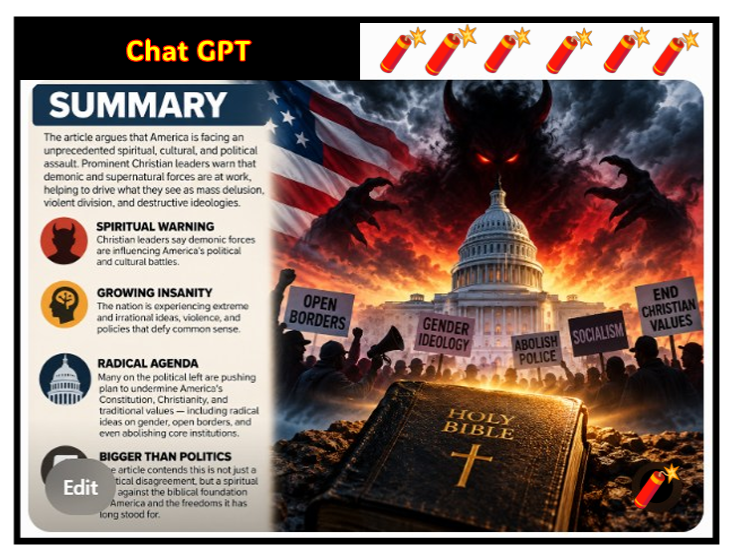
Comments